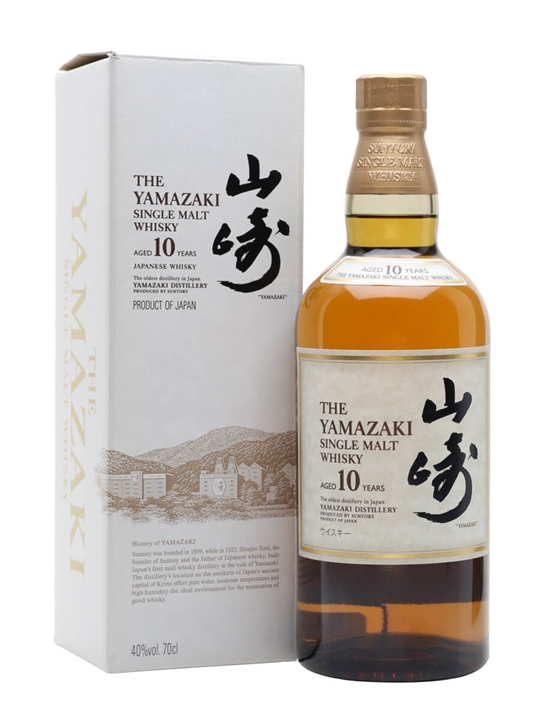

There are bottles you drink and bottles you study. The Yamazaki 10 Year Old, bottled sometime in the early 2000s, falls squarely into the latter category — though it rewards the drinker handsomely in both respects. At £550, this is no longer a casual purchase. It is a piece of Japanese whisky history, priced accordingly by a market that has, for better or worse, caught up with what many of us recognised years ago: that Yamazaki produces single malt of genuine world-class calibre.
Let me be direct about the context here. This is a discontinued expression. The Yamazaki 10 was quietly removed from regular production as demand for aged Japanese whisky far outstripped supply, and bottles from the 2000s era now circulate almost exclusively on the secondary market. That scarcity drives the price, and whether £550 represents fair value depends entirely on what you are looking for. If you want an excellent dram to pour on a Tuesday evening, there are dozens of options at a fraction of the cost. If you want a snapshot of Japanese single malt whisky at a specific moment in its ascendancy — before the global frenzy, before the allocation shortages — then this bottle has something to say.
At 40% ABV, this is bottled at a strength that was standard for Japanese expressions of that era. It is approachable by design, a ten-year-old single malt that was originally intended as an accessible entry point to the Yamazaki range rather than a collector's trophy. The irony of its current market position is not lost on me. What was once an everyday pour in Japanese bars has become a trophy bottle in Western auction houses.
What to Expect
The Yamazaki house style leans towards elegance and restraint. A ten-year maturation at 40% ABV suggests a whisky built around delicacy rather than power — light-bodied, clean, with the kind of poise that Japanese distilling became famous for. This is not a whisky that shouts. It is one that asks you to pay attention. Expect a refined, gently fruity character with soft oak influence. The 2000s bottling era is generally well regarded among collectors, representing a period when stock quality was high and production was still comfortably meeting demand.
The Verdict
I score this 7.9 out of 10, and I want to explain why that number sits where it does. The whisky itself is genuinely good — a polished, well-constructed Japanese single malt that demonstrates exactly why the category captured the imagination of drinkers worldwide. It is not, however, the most complex or challenging dram in the Yamazaki range, and at 40% ABV it can feel slightly restrained compared to what we now expect from premium single malts. The score reflects the liquid in the glass, not the price on the tag. As a drinking experience, it is elegant, satisfying, and thoroughly well made. As an investment or a piece of whisky history, its value is harder to quantify — but there is genuine pleasure in opening something from this particular chapter of Japanese whisky.
Best Served
Neat, at room temperature, in a tulip-shaped nosing glass. Give it five minutes to open up before your first sip. If you find it too tight, a few drops of soft water will coax it along nicely. This is also a whisky that works beautifully in a classic Japanese Highball — tall glass, quality soda, plenty of ice — though at this price point, I suspect most owners will prefer to savour it undiluted. I would not fault either approach.