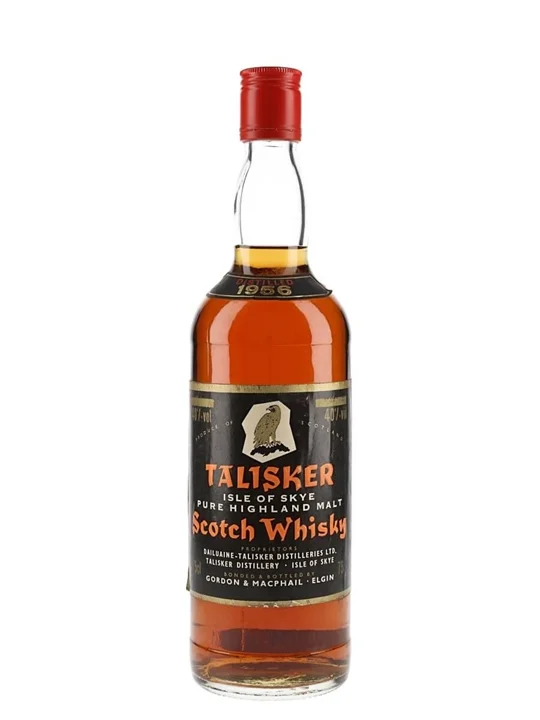

There are bottles you review, and there are bottles that stop you mid-pour. This Talisker 1956, bottled sometime in the 1980s by Gordon & MacPhail, belongs firmly in the latter category. It arrived without fanfare — no ornate presentation box, no gilded leaflet — just a bottle carrying a vintage date that predates most of the whisky industry's modern era. Distilled in 1956 and left to mature for what amounts to roughly a quarter-century or more before G&M saw fit to bottle it, this is a whisky from a period when production methods, yeast strains, and barley varieties were markedly different from what we encounter today.
Gordon & MacPhail's role here cannot be understated. As independent bottlers, they have long held some of the most extraordinary casks in Scotland, and their Talisker holdings from this era are the stuff of serious collector interest. At 40% ABV, this was bottled at the standard strength of its time — before cask strength releases became the norm for prestige bottlings. Some will see that as a limitation. I see it as a window into how whisky was meant to be enjoyed in that period: approachable, considered, and unforced.
What to Expect
Without detailed tasting notes to hand, I can speak to what a Talisker of this vintage and maturation length typically represents. We are firmly in the territory of old-style Island malt — a whisky shaped by decades in oak, where the maritime character Talisker is known for will have softened and deepened considerably. Expect the peppery punch of a younger Talisker to have receded, replaced by something altogether more layered and contemplative. Whiskies of this age and era tend to carry a waxy, almost textile quality, with dried fruit complexity and a coastal undertone that never entirely disappears. The extended maturation at a lower era of warehouse temperatures — before climate-controlled storage became common — would have allowed a slow, patient interaction between spirit and wood.
At £3,500, this is not a casual purchase. But within the context of 1950s-distilled single malt from a major distillery, bottled by one of Scotland's most respected independent houses, the price reflects genuine scarcity rather than marketing inflation. Bottles from this vintage simply do not appear with any regularity, and when they do, they tend not to linger on shelves.
The Verdict
I give this an 8.2 out of 10 — a strong score that reflects both the historical significance and the quality one can reasonably expect from a Gordon & MacPhail bottling of this calibre. It loses a fraction for the 40% ABV, which may leave some drinkers wishing for a touch more intensity, and for the inevitable uncertainty that comes with any bottle of this age — condition and storage history matter enormously. But as a piece of whisky history from one of Skye's most celebrated distilleries, handled by bottlers who understood exactly what they held, this is a compelling and serious bottle.
Best Served
Neat, at room temperature, in a tulip-shaped nosing glass. Give it fifteen minutes to open after pouring — a whisky of this age has earned the right to wake up slowly. A few drops of still water may coax out additional complexity, but I would resist the temptation to add more. This is not a whisky for cocktails or ice. It is a whisky for a quiet evening, an unhurried glass, and the kind of attention that sixty-odd years of history deserve.