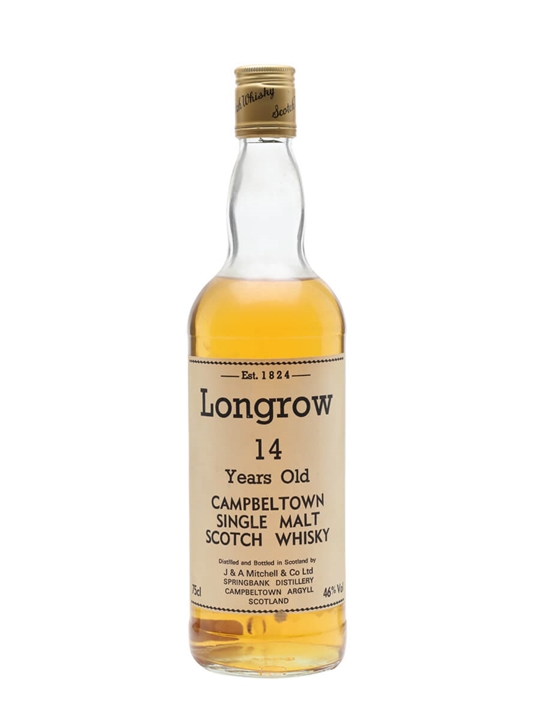

There are bottles you drink, and there are bottles that represent a moment in time. The Longrow 14 Year Old, bottled sometime during the 1980s, falls firmly into the latter category. At £4,000, this is not a casual purchase — it is an acquisition, a piece of Campbeltown history sealed in glass. I had the privilege of sitting with this whisky recently, and it reminded me why this small peninsula town on Scotland's west coast continues to command such reverence among serious collectors.
Campbeltown was once the whisky capital of Scotland, home to more than thirty distilleries at its peak. By the time this Longrow was being laid down in the late 1960s or early 1970s, that number had dwindled to a precious few. What survived was not diluted — it was distilled, quite literally, into something more concentrated, more purposeful. Longrow as an expression has always carried the heavier, more heavily peated character within the Campbeltown tradition, and a 14-year-old bottling from this era represents a style of production that simply does not exist in the same form today.
At 46% ABV, this was bottled at a strength that suggests confidence in the spirit. No chill-filtration concerns of the modern era here — this is whisky from a period when bottling decisions were made with less marketing calculus and more regard for what the cask delivered. Fourteen years is a considered age for a peated Campbeltown malt: long enough for the wood to temper and integrate with that coastal smoke, but not so long that the distillery character gets buried beneath oak influence.
What to Expect
Without dissecting individual notes — this is, after all, a bottle whose character will vary with storage conditions over four decades — I can speak to the broader style. Longrow from this period carries the maritime, briny backbone that defines Campbeltown, layered with a peat smoke that sits closer to oily and medicinal than the bonfire char of Islay. The 14-year maturation would have softened the edges, likely introducing a waxy, slightly fruity complexity that complements rather than competes with the smoke. This is not a whisky that shouts. It is one that holds your attention through depth and quiet authority.
The Verdict
I score this 8.1 out of 10. That reflects genuine quality and historical significance, tempered by the reality that at £4,000, this bottle asks a great deal of the buyer on faith. The whisky itself, judged on pedigree, era of production, bottling strength, and the sheer rarity of 1980s Campbeltown single malts, earns its place in any serious collection. It is not the highest-scoring whisky I have reviewed, but it may be among the most meaningful — a snapshot of a region's resilience during its leanest years. For the collector who understands what Campbeltown represented in that period, this bottle needs no further justification.
Best Served
If you are fortunate enough to open this, serve it neat in a tulip glass at room temperature. Give it fifteen minutes to breathe after pouring. A few drops of still water — no more — will open the structure without dismantling it. This is not a whisky for cocktails, highballs, or ice. It is a whisky for a quiet room and undivided attention.