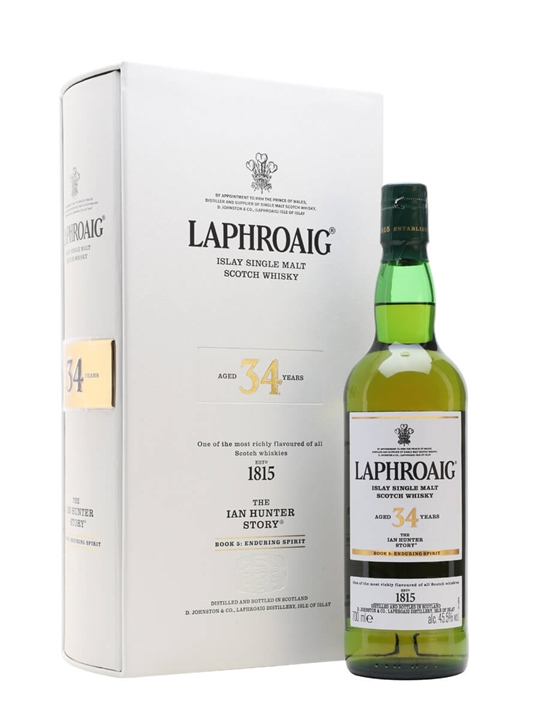

There are bottles you buy to drink, and there are bottles you buy because they represent something. The Laphroaig 1989 — the fifth and final chapter in The Ian Hunter Story series — is firmly in the latter camp, though it absolutely deserves to be opened. Distilled in 1989 and left to mature for 34 years, this is a whisky that carries serious weight, both in what it represents and what it costs at £1,235.
For context, The Ian Hunter Story is Laphroaig's series honouring their last family distillery manager, Ian Hunter, who ran the operation until 1954. Each release has explored a different facet of the distillery's character, and this fifth chapter closes the book. At 34 years old and bottled at 45.5% ABV, it sits at a strength that suggests confidence — no cask strength theatrics, but enough body to tell you this wasn't watered down to hit a number. Someone made a deliberate call here, and I respect that.
What to Expect
I want to be upfront: a 34-year-old Laphroaig is not going to taste like the 10 you keep on your shelf. Three and a half decades in oak fundamentally reshape what comes out the other end. The peat that defines younger Laphroaig — that medicinal, iodine-forward punch — will have softened and integrated over time. What you typically get with aged Islay malts is a conversation between the smoke and the wood, where neither shouts over the other. At 45.5%, there should be enough texture to carry the complexity you'd expect from whisky that's been sitting in a warehouse since the Berlin Wall came down.
This is the kind of dram where you sit down and pay attention. It's not background whisky. It's not a casual pour. At this age and price point, it demands — and rewards — your full focus.
The Verdict
Is it worth £1,235? That depends entirely on what you're looking for. As a piece of Laphroaig history, it's the final chapter of a series that won't be repeated. As a drinking experience, a 34-year-old Islay single malt at a well-chosen bottling strength is genuinely rare. Most distilleries would have either bottled this younger or pushed it to cask strength — the restraint shown at 45.5% suggests real care in how this was presented.
I'm giving this an 8.5 out of 10. It loses half a point because at this price, it's simply out of reach for most whisky drinkers, and I can't pretend that doesn't matter. But the whisky itself — the age, the pedigree, the thoughtful bottling strength, and the significance of closing out the Hunter series — earns its score honestly. If you have the means and the occasion, this is a bottle worth owning and, more importantly, worth opening.
Best Served
Neat, at room temperature, in a Glencairn glass. Add a few drops of water if you like — at 45.5% it can handle it — but give it at least fifteen minutes to breathe after pouring. This is not a whisky you rush. Pour it when the evening has slowed down, when you've got nowhere to be, and when you can give it the time it's asking for. A 34-year-old dram has waited long enough. The least you can do is return the favour.