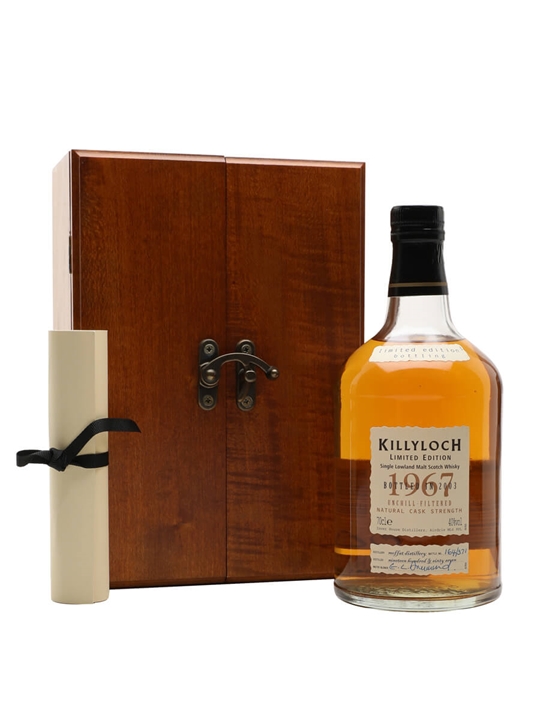

There are bottles that sit on a shelf and bottles that stop you in your tracks. Killyloch 1967, a 36 Year Old Lowland Single Malt, is firmly in the latter category. This is a whisky from a distillery that no longer exists — a ghost of the Lowlands, bottled at 40% ABV after more than three decades in cask. At £3,750, it demands serious consideration before purchase, but for collectors and students of Scotch history alike, it represents something genuinely rare: a window into a style of Lowland malt-making that has all but vanished.
Killyloch is one of those names whispered among collectors with a reverence usually reserved for Port Ellen or Brora. The distillery operated for a remarkably short period, and surviving bottles from the 1960s are scarce. A 1967 vintage, aged 36 years, is the kind of release that simply does not come around twice. Whatever stock remains is finite and shrinking. That alone places this bottle in rarefied territory.
At 40% ABV, this has been bottled at a strength that prioritises accessibility over cask-strength intensity. Some purists may raise an eyebrow at that, but I would argue there is a case to be made: with a whisky of this age, a gentler proof can allow the full spectrum of what decades in oak have created to present itself without the burn of higher alcohol. Thirty-six years is a long time for spirit and wood to negotiate, and the result of that conversation deserves to be heard clearly.
The Lowland style — historically lighter, more delicate, often with a grassy or floral character — is underrepresented in aged expressions. Most of the region's surviving distilleries focus on younger, approachable releases. To encounter a Lowland malt with this kind of maturity is to encounter something that challenges assumptions about what the region is capable of producing. Extended ageing has a way of adding weight and complexity that can redefine a whisky's regional identity entirely.
Tasting Notes
Specific tasting notes are not available for this bottling at the time of review. What I can say, from experience with aged Lowland malts of this era, is that you should expect a whisky that has moved well beyond the light, cereal-forward profile of its youth. At 36 years, the oak influence will be substantial — likely contributing layers of dried fruit, beeswax, old leather, and a gentle tannic structure. The Lowland DNA may still reveal itself in a certain elegance and restraint that distinguishes it from a Speyside or Highland malt of equivalent age.
The Verdict
I am giving Killyloch 1967 an 8.2 out of 10. This is a score that reflects both the exceptional rarity of the liquid and the sheer improbability of its existence. A 36-year-old single malt from a silent Lowland distillery, vintage 1967 — there is almost nothing else like it on the market. The price is significant, but it is not unreasonable for what you are buying: a piece of Scotch whisky history that cannot be replicated. This is a bottle for the collector who understands provenance, for the enthusiast who wants to taste something that the industry will never produce again. It earns its score through scarcity, heritage, and the quiet confidence of a whisky that has spent longer in cask than most of us spend in a career.
Best Served
Neat, at room temperature, in a tulip-shaped nosing glass. If you have spent £3,750 on a bottle, you owe it the dignity of being tasted without interference. A few drops of still water may open it further after you have taken your first impressions — at 40% ABV it should not need much coaxing. Give it time in the glass. A whisky that has waited 36 years deserves at least twenty minutes of yours.