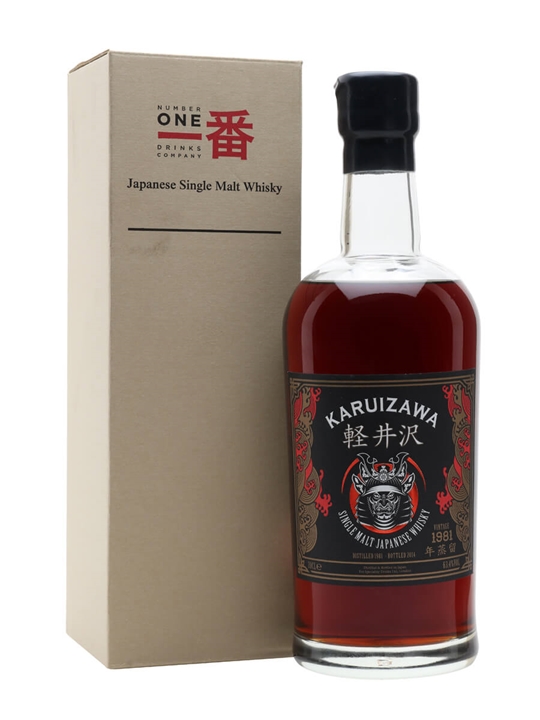

There are bottles you review, and there are bottles that demand a degree of reverence before you even crack the seal. The Karuizawa 1981, bottled in 2014 after what amounts to over three decades maturing in sherry cask, belongs firmly in the latter category. At 63.4% ABV and carrying a price tag of £15,000, this is not a casual purchase — it is a commitment, and one that says as much about the buyer as it does about the liquid inside.
Karuizawa is, of course, the ghost distillery that has become the most sought-after name in Japanese whisky collecting. Production ceased years before this bottle was even drawn from cask, which means every release shrinks a finite and irreplaceable pool. That scarcity alone would drive interest, but what makes Karuizawa genuinely compelling to those of us who care more about what is in the glass than what is on the secondary market is the house style itself: sherry-forward, full-bodied, and unapologetically intense in a way that feels closer to the old Speyside tradition than to the lighter, more delicate profile many associate with Japanese single malt.
What to Expect
A 1981 vintage bottled at natural cask strength of 63.4% after prolonged sherry cask maturation — you should expect something with serious weight and concentration. Over thirty years in oak at that strength suggests a whisky where the cask influence runs deep, likely rich with dried fruit character, dark sugars, and the kind of tannic structure that rewards patience. The high ABV is not a gimmick here; it is a statement of intent. This was bottled without dilution because the distiller — or more accurately, the bottler — judged that the spirit could carry it. At this age and strength, the interplay between wood and spirit becomes the entire conversation.
I would note that the distillery is not confirmed on this particular bottling, which is worth flagging for collectors. Provenance matters at this price point, and any prospective buyer should satisfy themselves on the chain of custody before committing. That said, the vintage date, cask type, and ABV are consistent with known Karuizawa releases from this era.
The Verdict
At 7.8 out of 10, this is a whisky I rate highly — though I suspect some will question why not higher for a bottle of this rarity and cost. My answer is straightforward: rarity and price are not flavour. I score what is in the glass, and while this is undoubtedly an exceptional single malt with the kind of depth and complexity that only decades of maturation can produce, the unconfirmed distillery detail and the sheer financial barrier to entry temper my enthusiasm slightly. For collectors and serious enthusiasts with the means, this is a remarkable piece of whisky history. For anyone chasing pure drinking pleasure per pound spent, there are extraordinary drams available for a fraction of this price. But that rather misses the point. Some bottles exist at the intersection of craft, time, and irreplaceable provenance — and this is one of them.
Best Served
Neat, in a tulip-shaped nosing glass, with plenty of time to open up. At 63.4% cask strength, a few drops of still water — added gradually — will unlock layers that the raw proof may hold back. Do not rush this. Give it twenty minutes in the glass before forming any judgement. A whisky that has waited over thirty years in oak deserves at least that much patience from the person drinking it.