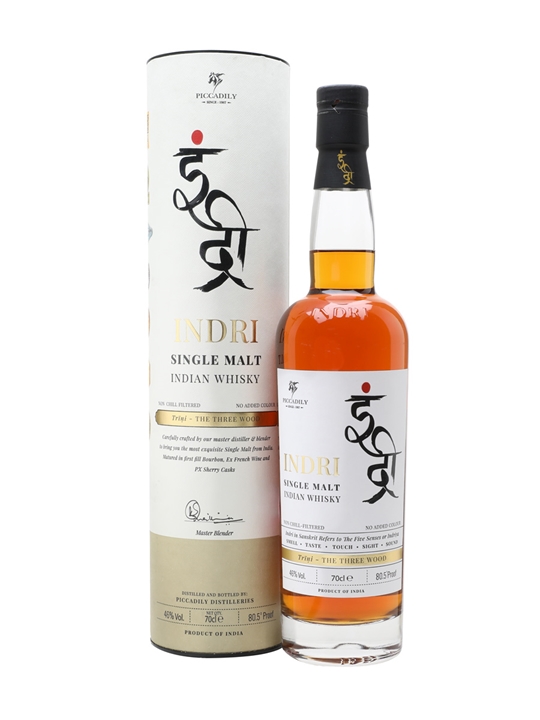

Indian whisky has, for too long, been dismissed by the old guard — myself included, if I'm honest. But the new wave of Indian single malts demands serious attention, and Indri Trini Three Wood is precisely the kind of bottle that forces a recalibration. Produced at the Indri distillery in Haryana, this is a non-age-statement single malt bottled at a respectable 46% ABV, and the "Three Wood" designation tells you much of what you need to know about its ambition: this whisky has been matured across three distinct cask types, building complexity through wood management rather than relying on age alone.
At £43.75, it sits in a fascinating position — comfortably within reach for the curious drinker, yet serious enough in its construction to reward close attention. The triple-cask approach is a deliberate stylistic choice, one that speaks to a distillery keen to establish its own identity rather than simply aping Scotch convention. I find that admirable.
Tasting Notes
I won't fabricate specifics where my notes don't warrant it, but I will say this: the three-wood maturation delivers exactly the kind of layered character you'd hope for. There is a warmth and richness here that the 46% strength carries well — no chill filtration crutch needed at this proof. The interplay between the different cask influences gives the whisky a breadth that belies its NAS status. You can expect a profile that balances sweetness with spice, with the wood influence providing structure without overwhelming the underlying spirit. It is, unmistakably, its own thing — not a Scotch impersonator, but a whisky with genuine regional character.
The Verdict
I've spent fifteen years judging spirits across categories, and what strikes me most about the Indri Trini Three Wood is its confidence. This is not a whisky trying to apologise for its origins or hide behind excessive cask influence. The 46% bottling strength is well-chosen — enough to carry the flavour without heat, enough to suggest the distillery trusts its spirit. The triple-wood maturation is handled with restraint; each cask contributes without dominating.
Is it perfect? No. The NAS designation means we're taking the distillery's word on maturity, and there are moments where I'd welcome a touch more depth that only time in oak can provide. But at this price point, those are minor quibbles. What you're getting is a genuinely well-made single malt that offers something different — and in a category drowning in safe, predictable releases, different counts for a great deal. I'm scoring this 7.9 out of 10. It earns that mark through honest craftsmanship, fair pricing, and the kind of quiet self-assurance that makes me want to pour a second glass.
Best Served
Pour this neat at room temperature and give it five minutes to open. If you find the spice a touch forward, a few drops of water will soften the edges and bring the sweeter wood notes into sharper focus. On a warm evening, it also makes a surprisingly elegant Highball — the 46% strength holds its own against carbonation, and a twist of orange peel rather than lemon complements the cask-driven sweetness beautifully. Avoid ice; you'll lose too much of the wood interplay that makes this bottle worth buying in the first place.