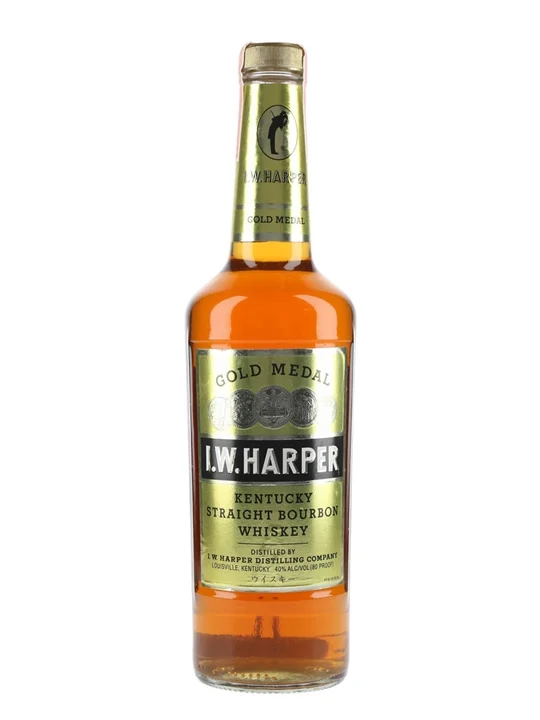

There's something about holding a bottle from another era that shifts your perspective. This I.W. Harper Gold Medal, bottled sometime in the 1980s, is a Kentucky Straight Bourbon that predates the modern bourbon boom by decades. Back then, bourbon wasn't cool — it was your grandfather's drink, something gathering dust on back bars while vodka and white rum had their moment. Which makes a bottle like this genuinely fascinating. You're not just drinking whiskey; you're drinking a snapshot of what American distilling tasted like before craft culture, before premium pricing, before Instagram.
I.W. Harper was once one of the most decorated bourbon brands in the country — the name "Gold Medal" wasn't marketing fluff but a reference to actual awards picked up at world expositions in the late 1800s and early 1900s. The brand had a long run as a prestige pour, particularly popular in export markets like Japan, where it developed a serious cult following. By the time this bottle was filled in the 1980s, American whiskey was in its long slump, but I.W. Harper kept quietly doing its thing.
At 40% ABV and carrying no age statement, this isn't a bottle that's trying to knock you sideways with proof or complexity. That's actually part of the appeal. Bourbon in this era was often bottled at a gentler strength, designed to be approachable and smooth rather than barrel-proof and challenging. For anyone used to modern bourbon bottled at 50%+ ABV, the difference is immediately noticeable — there's a softness and a roundness here that you just don't get when distillers are chasing bigger, bolder flavour profiles.
Tasting Notes
As a 1980s-era Kentucky Straight Bourbon at entry-level proof, you can expect the classic hallmarks of the style from that period: a gentle sweetness, likely corn-forward given the traditional mashbill expectations, with that distinctive old-bottle character that collectors talk about. Bourbon from this decade tends to carry a particular quality — some call it "dusty" character — that sets it apart from anything you'll find on shelves today. The lower ABV means the flavours tend to present themselves gently rather than demanding attention.
The Verdict
At £299, this is firmly in collector and enthusiast territory. You're paying for provenance, scarcity, and the simple fact that they stopped making bourbon like this a long time ago. Is it worth it? That depends entirely on what you're after. If you want raw power and complexity, there are better options at half the price. But if you want to understand what bourbon tasted like before the renaissance — before wheated mashbills became trendy, before single barrel programmes, before every distillery had a barrel-strength offering — this is a genuine time capsule. An 8 out of 10 from me, because it delivers exactly what it promises: classic Kentucky bourbon from an era we can't revisit, in excellent condition, from a brand with genuine historical weight. It's not trying to be something it isn't, and I respect that.
Best Served
Pour this one neat in a Glencairn or a small tumbler, at room temperature. Give it ten minutes to open up — older bourbon at 40% ABV rewards patience. If you're feeling adventurous, this would make an absolutely stunning Old Fashioned: a barspoon of rich demerara syrup, two dashes of Angostura, and an expressed orange peel. The lower proof means the cocktail won't be overly boozy, and whatever vintage character the bourbon carries will sit beautifully alongside the bitters. But honestly, with a bottle at this price point, I'd savour most of it neat and save one pour for that Old Fashioned — just to see what the 1980s taste like in a mixing glass.