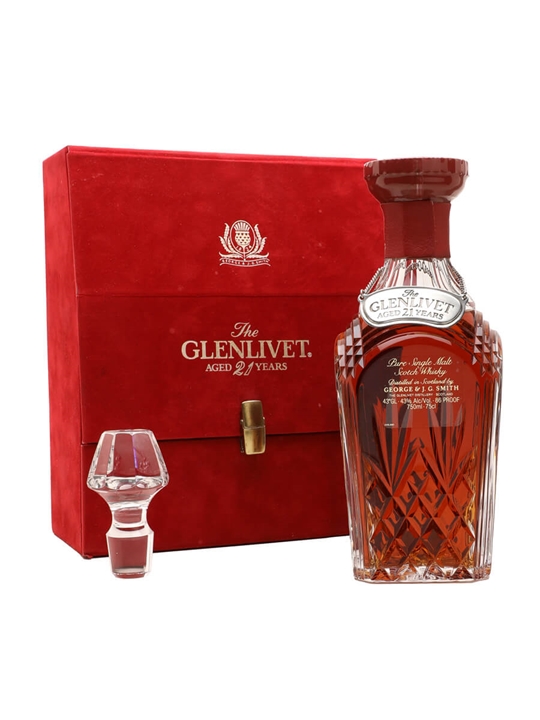

There are bottles you drink, and there are bottles you sit with. The Glenlivet 21 Year Old, bottled sometime in the 1980s, belongs firmly in the latter category. This is a whisky from an era when Glenlivet was still operating with a relatively modest number of stills, before the expansions that would later reshape its output. At 21 years of age and bottled at 43% ABV, it represents a style of Speyside single malt that the modern market has largely moved away from — unhurried, fully matured, and released at a strength that suggests quiet confidence rather than cask-strength theatre.
I should be clear about what we're dealing with here. A bottle from the 1980s means spirit distilled in the early-to-mid 1960s, an era when production methods, barley varieties, and warehouse conditions were meaningfully different from what we see today. The Glenlivet of that period was a smaller operation, and the character of the spirit reflected that scale. Twenty-one years in oak is a serious commitment, and at this age you'd expect the wood influence to be substantial — but at 43%, this was bottled to be approachable, not punishing. That balance between age and accessibility is something I find increasingly rare.
What to Expect
Speyside malts of this vintage and maturity tend toward a particular profile: rich, rounded, with the kind of depth that only genuine time in good wood can deliver. The Glenlivet house style has always leaned toward elegance over brute force, and two decades of maturation would only sharpen that refinement. At 43%, this is not a whisky that will overpower you. It will, however, reward patience. Every sip from a bottle like this is a conversation with a different decade, a different approach to whisky-making, and frankly a different set of priorities about what single malt should be.
The £1,250 price point places this firmly in collector and serious enthusiast territory. That is not a casual purchase, and I wouldn't pretend otherwise. But context matters — 1980s bottlings of well-regarded Speyside distilleries at 21 years of age are not getting more common. The market for old bottlings has moved sharply upward over the past decade, and a Glenlivet of this era carries both drinking merit and historical weight. You are paying for scarcity as much as quality, but the quality is genuinely there to justify the investment.
The Verdict
I rate this 8.5 out of 10. It earns that score not through spectacle but through pedigree and restraint. This is a whisky that does what the best aged Speyside malts have always done — it delivers complexity without demanding attention, richness without heaviness. The 1980s bottling era produced some outstanding examples of long-aged single malt, and The Glenlivet 21 is a credible representative of that period. It loses half a point because at this price, I hold every bottle to an exacting standard, and without confirmed provenance details on the distillery sourcing, there is a small margin of uncertainty that a collector should acknowledge. But as a drinking experience, this is serious whisky from a serious era.
Best Served
Neat, at room temperature, in a tulip-shaped nosing glass. If you've spent this kind of money on a bottle, give it the respect it deserves — no ice, no mixers. A few drops of still water at most, added gradually, to see how the whisky opens across the session. Pour modestly. Sit with it. A bottle like this is not meant to be rushed through in an evening; it is meant to be revisited over weeks, each pour revealing something the last one didn't. This is contemplation whisky, plain and simple.