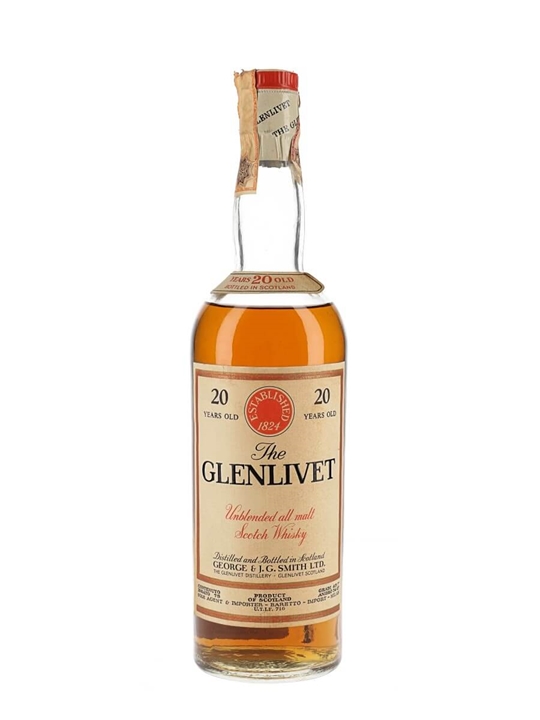

There are bottles you review, and there are bottles you sit with. The Glenlivet 20 Year Old, bottled sometime in the 1960s, belongs firmly in the latter category. This is a whisky from an era when Speyside distilling operated at a different tempo — smaller stills, longer fermentations, warehouses that hadn't yet been optimised for throughput. Holding a dram of this is holding a piece of that unhurried tradition, and at 45.7% ABV, it arrives with enough strength to suggest it was bottled with serious drinkers in mind.
Two decades in oak during the mid-twentieth century would have meant predominantly refill sherry casks and ex-bourbon wood of a quality we simply don't see in today's supply chain. The Glenlivet has always been regarded as the definitive Speyside style — fruited, elegant, gently floral — and a 20-year-old expression from this period sits at the intersection of house character and genuine maturity. At this age, you'd expect the distillery's signature approachability to have deepened into something more contemplative, with the kind of integrated oak influence that only time, not finishing tricks, can deliver.
What makes this bottle particularly compelling is context. The 1960s bottlings predate the whisky boom, the marketing era, the age-statement debates. This was whisky made and bottled for people who simply wanted good Scotch. There's an honesty to that which I find increasingly rare. The 45.7% strength is notable too — not quite cask strength, but meaningfully above the 40% standard that would become ubiquitous. It tells you something about the intended audience and the confidence the bottler had in what was inside.
Tasting Notes
I won't fabricate specific tasting notes from memory for a bottle of this age and scarcity — every surviving example will have its own story, shaped by decades of storage conditions. What I will say is that a well-kept Glenlivet of this vintage and maturity should deliver the kind of depth that modern expressions chase with multiple cask finishes but rarely catch. Expect richness without heaviness, complexity that unfolds rather than announces itself, and a finish that reminds you why patience used to be considered a virtue in this industry.
The Verdict
At £1,200, this is not an everyday purchase — but it is not priced for everyday drinking. This is a bottle for collectors, for historians of Scotch, and for anyone who wants to understand what Speyside tasted like before the modern era reshaped it. I've given it 8.4 out of 10, which reflects both its undeniable heritage value and the reality that purchasing a decades-old bottle always carries an element of uncertainty around storage. A well-stored example could easily score higher. What isn't in doubt is the calibre of what The Glenlivet was producing in this period — this distillery earned its reputation long before it became the world's best-selling single malt, and bottles like this are the proof.
Best Served
Neat, at room temperature, in a proper tulip-shaped nosing glass. If you're fortunate enough to open one, give it fifteen minutes to breathe before your first sip. A few drops of soft water — nothing more. This whisky has waited sixty-odd years; you can wait a quarter of an hour. Save the Highballs for younger stock.