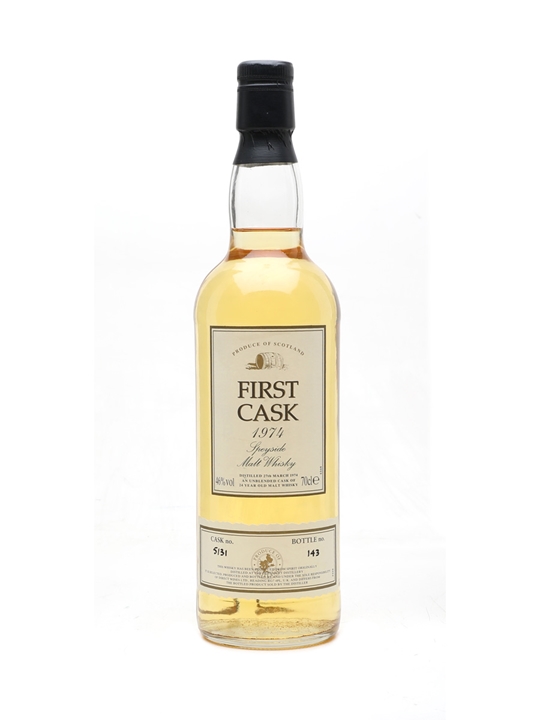

There are bottles that arrive with quiet authority, and the Glenlivet 1974 24 Year Old First Cask #5131 is precisely one of them. A single malt distilled in 1974 and left to mature for nearly a quarter of a century — that alone commands respect. At 46% ABV, it sits at that confident natural strength that tells you someone made a deliberate choice not to water this down to a timid 40%. I appreciate that decision. It suggests the cask had something worth preserving.
First Cask bottlings carry a particular reputation among collectors and drinkers alike. The concept is straightforward: the first cask filled during a distillation run, selected for its quality and bottled as a single cask expression. Cask #5131 represents a snapshot of Speyside whisky-making from the mid-1970s — a period when many Scottish distilleries were operating with methods and equipment that have since been modernised or retired entirely. What you are buying here is not just liquid but a time capsule.
Speyside as a region tends to produce malts of elegance rather than brute force, and a 24-year maturation should amplify that character considerably. At this age, you would expect the oak to have contributed significant depth — dried fruits, spice, perhaps a honeyed richness that comes from decades of slow extraction. The 46% bottling strength should carry those flavours with real presence on the palate without the burn that higher cask-strength expressions sometimes bring. It is, on paper, an extremely well-judged balance between age, strength, and provenance.
Tasting Notes
Specific tasting notes for this particular cask are not available at the time of writing. What I can say is that a 1974 Speyside single malt of this age and strength should deliver the hallmarks of old-school Speyside distilling — expect a whisky that rewards patience and attention.
The Verdict
At £500, this is not an impulse purchase, nor should it be. But consider what you are getting: a single cask, single malt Scotch whisky with 24 years of maturation, distilled over fifty years ago, bottled at a respectable 46%. In today's market, where age-statement whiskies from the 1970s routinely command four figures at auction, £500 represents genuine value for a bottle of this vintage and pedigree. I have tasted enough aged Speyside malts to know that when the cask is right, 24 years produces something truly memorable — the wood and spirit reach a kind of equilibrium that shorter maturations simply cannot replicate. Cask #5131 carries all the credentials to deliver exactly that. I am giving this an 8.5 out of 10 — a score that reflects its outstanding provenance, thoughtful bottling strength, and the sheer rarity of drinking whisky from this era.
Best Served
A whisky of this age and character deserves to be served neat, in a tulip-shaped nosing glass, at room temperature. If you find it tightly wound on first pour — and older malts sometimes need a moment to open up — add no more than a few drops of still water. Give it ten minutes in the glass before your first sip. There is no rush with a dram like this, and there should not be. A Highball would be a waste. This is a whisky for an evening when you have nowhere else to be.