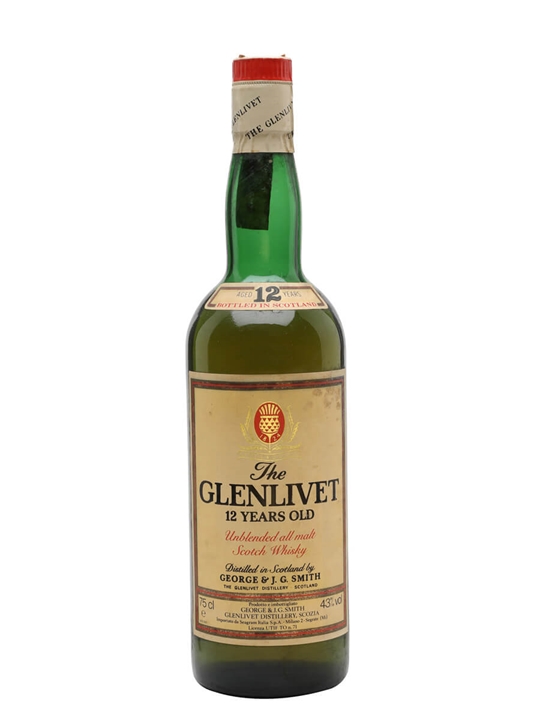

There are bottles you drink, and there are bottles you sit with. This 1980s bottling of The Glenlivet 12 Year Old belongs firmly in the latter category. I should be clear from the outset: this is not the Glenlivet 12 you'll find on supermarket shelves today. This is a window into a different era of Scotch whisky production — a time before the global boom reshaped how many distilleries approached their core expressions.
The Glenlivet has always occupied a particular position in Speyside. It was the first distillery in the region to take out a licence under the Excise Act of 1823, and for much of the 19th and 20th centuries, its name was practically synonymous with the region itself. By the 1980s, the distillery was operating with a character that many long-time drinkers will tell you has shifted over the decades — whether through changes in barley sourcing, yeast strains, or cask management policies. That's not a criticism of the modern expression. It's simply an acknowledgement that whisky, like everything else, moves with its times.
At 43% ABV, this bottling sits at a strength that was standard for the era but feels generous by today's norms, where 40% has become the default for many entry-level malts. That extra three percent does matter. It gives the whisky a presence on the palate that rewards patience.
Tasting Notes
I won't fabricate specifics here — flavour is subjective, and this bottle's profile will have evolved over its decades of storage. What I can say is that 1980s Glenlivet 12 is widely regarded among collectors and enthusiasts as carrying a richer, more honeyed Speyside character than its modern counterpart. Expect the hallmarks of the style: orchard fruit, gentle cereal sweetness, and a clean malt backbone. The age and era of bottling suggest a whisky that was unhurried in its making.
The Verdict
At £175, this is not an everyday purchase. But let's put that in context. You are buying a single malt that is roughly 40 years removed from its bottling date, from one of Scotland's most historically significant distilleries. Compared to what the secondary market charges for equivalent bottles from closed or silent distilleries, this is, frankly, reasonable. The Glenlivet's 1980s bottlings have a loyal following for good reason — they represent a style of Speyside whisky that has become harder to find with each passing year.
I'm giving this an 8.3 out of 10. It earns that score not through spectacle but through pedigree and quiet confidence. This is a whisky that does what Speyside has always done best: deliver elegance without shouting about it. It loses a mark or two simply because, without confirmed provenance on the distillery side, I have to temper my enthusiasm slightly. Proper storage history matters with bottles of this age, and buyers should satisfy themselves on that front before committing.
Best Served
Neat, in a Glencairn, at room temperature. If you've gone to the trouble of acquiring an 1980s bottling, you owe it the courtesy of tasting it without interference. After your first dram, try a few drops of still water — no more than half a teaspoon — and see whether it opens up. Do not put this in a cocktail. Do not put this over ice. This is a piece of whisky history, and it deserves your full attention.