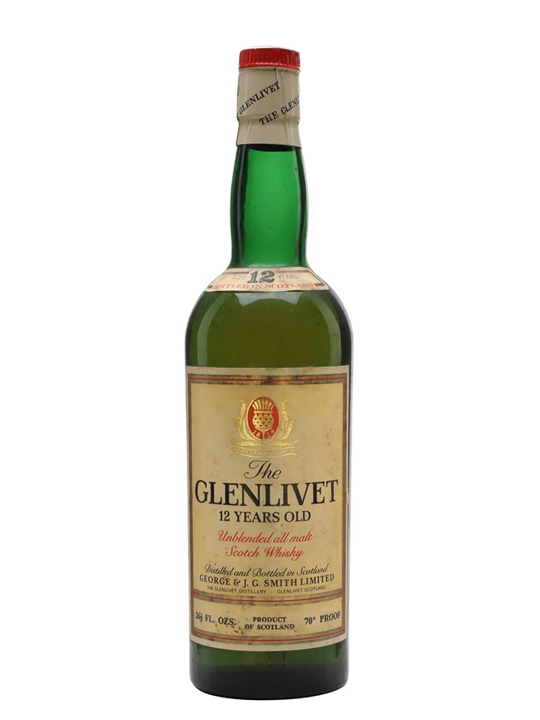

There are bottles you drink, and there are bottles you sit with. The Glenlivet 12 Year Old from the 1970s bottling era falls firmly into the latter category — a whisky that asks you to slow down and consider what single malt Scotch used to taste like before the global boom reshaped the industry. At £225, you're not paying for liquid alone. You're paying for a window into a different era of Speyside distilling, and in my experience, that window is worth looking through.
The Glenlivet has always occupied a peculiar position in the whisky world. It was the first distillery to take out a legal licence in the Livet parish back in 1824, and by the 1970s it had established itself as the benchmark Speyside single malt — the one against which others were measured. What makes these older bottlings so fascinating is what surrounded them: different barley strains, different yeast cultures, worm tub condensers still in wider use, and a general approach to maturation that leaned heavily on ex-sherry casks in a way that has become harder to replicate at scale. A 1970s bottling of a 12-year-old expression means we're looking at spirit distilled in the early-to-mid 1960s, aged through a period when The Glenlivet was still a relatively modest operation compared to the giant it became.
Bottled at 40% ABV, this sits at the standard strength of its day. Some modern drinkers might wish for a few extra percentage points, but I'd caution against dismissing it on that basis alone. Whiskies from this period were often built differently — the distillate carried more weight at lower strengths than many contemporary releases manage at 43% or 46%. The character tends to be rounder, more integrated, with the kind of cohesion that only comes from unhurried maturation in good wood.
Tasting Notes
I won't fabricate specific tasting notes where my memory doesn't serve with precision. What I will say is this: 1970s Glenlivet 12 belongs to a style of Speyside whisky that modern expressions reference but rarely replicate. Expect a richness and depth that feels old-fashioned in the best possible sense — the kind of whisky that reminds you why Speyside earned its reputation in the first place. If you've had other 1970s single malts from the region, you'll recognise the family resemblance: a certain waxy quality, a fullness on the palate, and a finish that lingers longer than the ABV might suggest.
The Verdict
At 8.4 out of 10, this is a whisky I'd recommend to anyone serious about understanding how single malt has evolved over the past half-century. It's not the most explosive dram you'll ever pour — it was never trying to be. What it offers instead is composure, balance, and a sense of place and time that you simply cannot get from current production. The price reflects its scarcity rather than any attempt at luxury positioning, and for a well-stored bottle from this era, £225 remains reasonable against comparable vintage bottlings from other distilleries. This is living history in a glass, and it drinks like it.
Best Served
Neat, in a tulip glass, at room temperature. If you've waited this long to open a bottle from the 1970s, give it the respect of ten minutes in the glass before your first sip. A few drops of still water after the initial tasting will open the structure, but I'd resist anything more than that. This is not a whisky for cocktails or ice. It is a whisky for a quiet evening and your full attention.