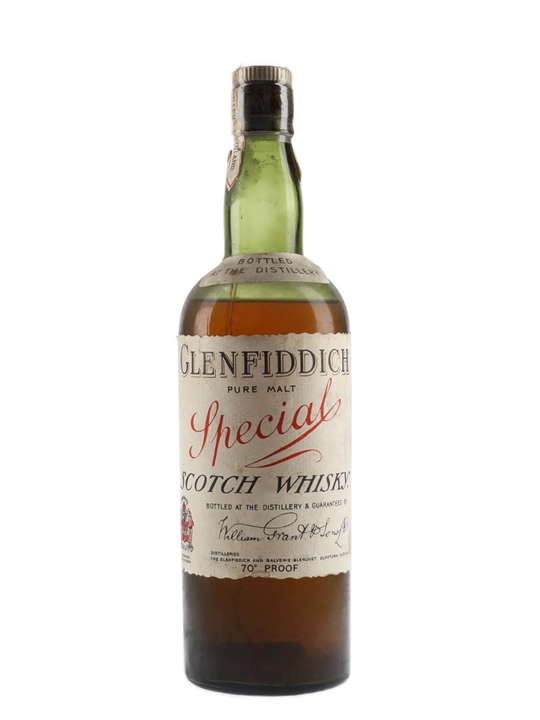

There are bottles you drink, and there are bottles you sit with. The Glenfiddich Special, believed to have been bottled in the 1950s, belongs firmly in the latter category. This is a piece of Speyside history — a single malt from an era when whisky was made with fewer concessions to scale and considerably more patience. At £3,500, it demands serious consideration, but for collectors and those who appreciate what post-war Scotch represents, it offers something no modern bottling can replicate: a window into how Speyside tasted before the world caught on.
Style & Character
This is a non-age-statement single malt bottled at 40% ABV — standard for its era, when higher-strength bottlings were the exception rather than the rule. What matters here is context. A 1950s bottling means spirit distilled in the late 1940s or earlier, a period when barley was floor-malted on site, stills were coal-fired, and worm tub condensers were standard rather than nostalgic. The resulting character from that generation of Speyside production tends toward a richer, more waxy and sulphur-free profile than much of what we encounter today. I would expect old orchard fruit, a certain malty sweetness, and a gentle oakiness that speaks to refill sherry casks rather than anything heavily seasoned.
I should note that while the label reads Glenfiddich, the distillery attribution has not been independently confirmed. Provenance matters enormously at this price point, and any prospective buyer should satisfy themselves on that front before committing. The bottle condition, fill level, and label integrity all factor into the equation. This is as much an auction-room purchase as it is a whisky purchase.
The Verdict
I give this a 7.8 out of 10. That may strike some as restrained for a bottle of this age and rarity, but I score on drinking merit, not scarcity. At 40% ABV, there is an inherent ceiling on intensity and complexity — this was bottled to the conventions of its time, not to showcase cask strength fireworks. What it offers instead is subtlety, historical significance, and the unmistakable character of mid-century Speyside distillation. It is a genuinely rewarding whisky to taste, and a remarkable artefact to hold. The unconfirmed distillery attribution is the only thing keeping me from scoring higher; certainty of origin would add meaningfully to both the experience and the investment case.
For collectors, this is a compelling acquisition. For drinkers, it is an opportunity to taste something that simply cannot be made today — not because the skill is lost, but because the raw materials, the methods, and the unhurried pace of that era have moved on. That alone makes it worth the price of admission for anyone who takes Scotch seriously.
Best Served
Neat, at room temperature, in a tulip-shaped nosing glass. Give it ten minutes to open after pouring — whisky of this age and delicacy rewards patience. If you feel it needs it, a single drop of water and no more. This is not a whisky for cocktails or ice. It is a whisky for a quiet room and an unhurried evening.