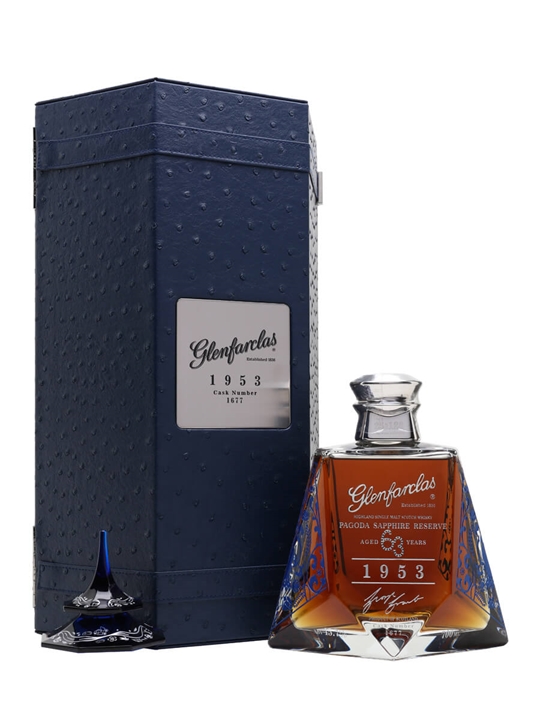

There are bottles that sit behind glass, and then there are bottles that belong behind glass. The Glenfarclas 1953 Pagoda Sapphire Reserve (Silver) is the latter — a 63-year-old Speyside single malt that was laid down in the year Edmund Hillary summited Everest, and has been quietly maturing ever since. At £28,500, this is not a casual purchase. It is a statement, and in my view, one that largely delivers on its extraordinary promise.
Sixty-three years in oak is a feat of patience and, frankly, nerve. Most casks of that age have either surrendered entirely to the wood or faded to something thin and tannic. That this whisky has been bottled at 45.7% ABV — a notably confident strength for something of this vintage — tells you immediately that whoever was minding this cask knew what they had. There was no need to dilute it into oblivion or prop it up with cask-strength bravado. It arrived at a natural, self-assured strength, and that speaks volumes about the quality of the spirit and the storage conditions over those six decades.
The Pagoda Sapphire Reserve series occupies rarefied air even within the world of ultra-aged Speyside malts. At 63 years old, you are dealing with a whisky that predates the majority of distillery modernisations, the shift to continuous production, the rationalisation of the 1980s. This is spirit from a different era of Scottish whisky-making, when things were done by hand and by instinct as much as by design. The Speyside character — that essential fruitiness, that honeyed weight — will have been shaped and deepened by decades of slow interaction with the cask, producing something that no amount of modern craft can replicate. You simply cannot engineer this kind of complexity; you can only wait for it.
Tasting Notes
I will not fabricate specific notes where my records are incomplete. What I can say is this: a Speyside single malt of this age and strength, from a distillery with Glenfarclas's reputation for sherry cask management and traditional practice, will carry extraordinary depth. Expect concentrated dried fruit, polished oak, old leather, and a waxy, almost resinous texture. The 45.7% ABV suggests a whisky that still has backbone — this will not be a fragile antique but something with genuine presence in the glass.
The Verdict
An 8.6 out of 10 for a bottle at this price point might seem restrained, but I mean it as genuine, hard-won praise. A perfect score would require the kind of transcendent tasting experience that only a handful of whiskies in my career have delivered. What the Glenfarclas 1953 offers is something almost as valuable: authenticity. This is real whisky from a real place, made by real people, and left alone long enough to become something unrepeatable. The price reflects its scarcity and its history, and while I would never call £28,500 a bargain, I will say this — for a 63-year-old single malt bottled at natural strength, it is not without justification. For the serious collector or the once-in-a-lifetime occasion, this bottle earns its place.
Best Served
Neat, in a tulip glass, at room temperature. Give it twenty minutes to open after pouring — a whisky that has waited 63 years deserves at least that. A few drops of still water may coax out further nuance, but add them sparingly. This is not a whisky for cocktails or ice. It is a whisky for silence, attention, and respect.