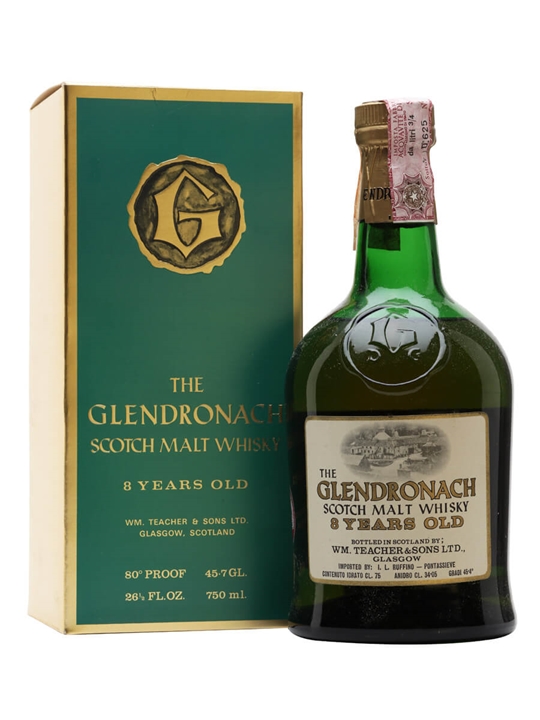

There are bottles you drink, and there are bottles you sit with. The Glendronach 8 Year Old, bottled sometime in the 1970s, falls squarely into the latter category. This is a piece of Highland whisky history — a snapshot of how single malt was made before the industry became obsessed with cask finishes, limited editions, and marketing narratives. At 45.4% ABV, it was bottled at a strength that suggests confidence in the liquid itself, a few points above the standard that would later become the norm. That alone tells you something about the era and the intent behind this whisky.
GlenDronach has long been one of the Highlands' most quietly revered distilleries, and this bottling comes from a period when its reputation was built almost entirely on word of mouth among serious drinkers. An 8-year-old age statement might raise eyebrows today, but context matters enormously here. Distilling practices, barley varieties, and maturation conditions in the early 1970s were fundamentally different from what we see now. Warehousing was traditional, dunnage-style, and the pace of production allowed for a level of care that has become increasingly rare. Eight years in those conditions could yield a depth of character that many modern whiskies struggle to achieve at twelve or fifteen.
At 45.4%, this sits in a sweet spot — enough strength to carry the weight of the spirit without overwhelming the drinker. It is worth remembering that bottling at higher strengths was not the commercial calculation it is today; it was simply how the whisky presented itself. You are tasting something honest, undiluted by market pressures or focus groups.
Tasting Notes
I will not fabricate specific tasting notes for a whisky of this age and rarity — every bottle will have evolved differently over the decades. What I can say is that Highland single malts from this era, particularly from sherry-forward distilleries like GlenDronach, tend to offer a richness and textural quality that modern expressions often chase but seldom catch. Expect the unexpected. Each pour from a bottle like this is a conversation with the past.
The Verdict
At £850, this is not a casual purchase, and it should not be. You are paying for provenance, for a window into a style of Scotch whisky that no longer exists in active production. The 8-year age statement is irrelevant in the way that the age of a vintage wine is irrelevant — what matters is when it was made and who made it. I give this a 7.8 out of 10. It loses a fraction for the simple uncertainty that comes with any bottle of this vintage — condition, storage history, and fill level all play a role, and the buyer must accept a degree of risk. But as a collectible with genuine drinking merit, as a piece of Highland single malt heritage bottled before the whisky boom rewrote the rules, it earns its place in any serious collection. This is whisky as it was, not as marketing departments wish it to be.
Best Served
Neat, in a tulip glass, at room temperature. Give it ten minutes to breathe after pouring — a whisky that has spent fifty-odd years in glass deserves a moment to reacquaint itself with air. If you feel compelled, a few drops of still water may open it further, but I would taste it unadorned first. This is not a whisky for cocktails or casual mixing. It is a whisky for sitting quietly with, preferably with good company and no distractions.