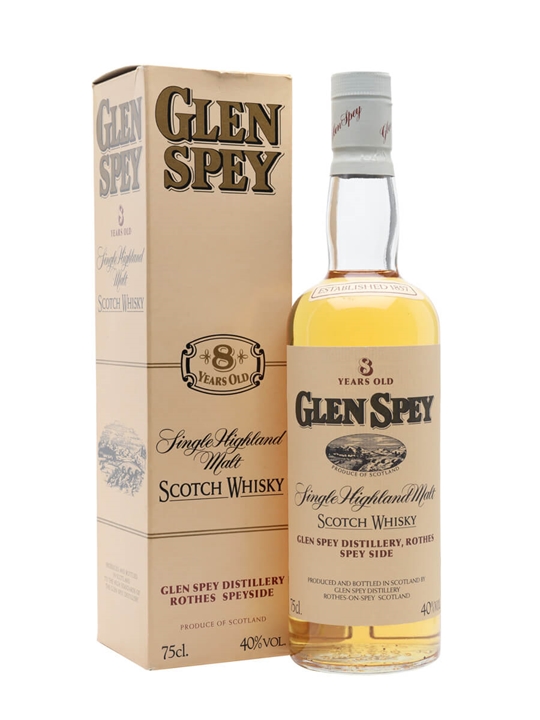

There is something quietly thrilling about holding a bottle that has sat undisturbed for the better part of four decades. This Glen Spey 8 Year Old, bottled sometime in the 1980s, belongs to a category of whisky that demands you slow down and consider what you are actually drinking — not just the liquid, but the era it represents. At 40% ABV and eight years of age, it arrived on shelves during a period when single malts were still fighting for shelf space against the blended giants. That alone makes it worth your attention.
Glen Spey has never been a household name, and that is precisely part of the appeal. Speyside is crowded with famous distilleries jostling for recognition, but the quieter operations — the ones that spent decades supplying blending houses before anyone thought to bottle them as singles — often carry a character that feels less polished and more honest. An 1980s bottling at this age statement gives you a window into how Speyside malt tasted before the modern craft boom reshaped expectations and marketing language around it. This is old-school Scotch, plain and simple.
At eight years old and bottled at the standard 40%, this was never designed to be a showpiece. It was made to be drunk, and drunk well. The lower age statement and bottling strength suggest a malt that leans into accessibility — the kind of dram that would have been poured without ceremony in a Scottish hotel bar, enjoyed by people who did not need a flavour wheel to tell them what they liked. I find that directness refreshing.
Tasting Notes
I will be straightforward: specific tasting notes for a bottle of this age and scarcity are not something I am prepared to fabricate. Condition varies enormously with vintage bottlings, and storage history matters as much as what went into the cask. What I can say is that 1980s Speyside single malts of this profile typically deliver a gentle, malty sweetness with orchard fruit and a clean cereal backbone — the hallmarks of the region before heavy sherry influence became the dominant selling point. If this bottle has been stored well, you should expect something graceful and unforced.
The Verdict
At £350, you are paying for provenance and rarity rather than age statement or cask strength muscle. That is a fair exchange if you understand what you are buying. This is not a whisky you purchase to impress guests with a number on the label. It is one you buy because you want to taste a piece of Speyside history from an era when the industry operated on different terms entirely. I have given it an 8.2 out of 10 — a score that reflects genuine quality and collectible appeal, tempered only by the modest ABV and the reality that condition on any bottle this old carries an element of uncertainty. For the curious drinker and the serious collector alike, it earns its place.
Best Served
Neat, at room temperature, in a tulip-shaped nosing glass. If you have waited forty years for a pour of this, you owe it — and yourself — the full experience without dilution. Give it ten minutes to open after pouring. No ice, no water, no rush.