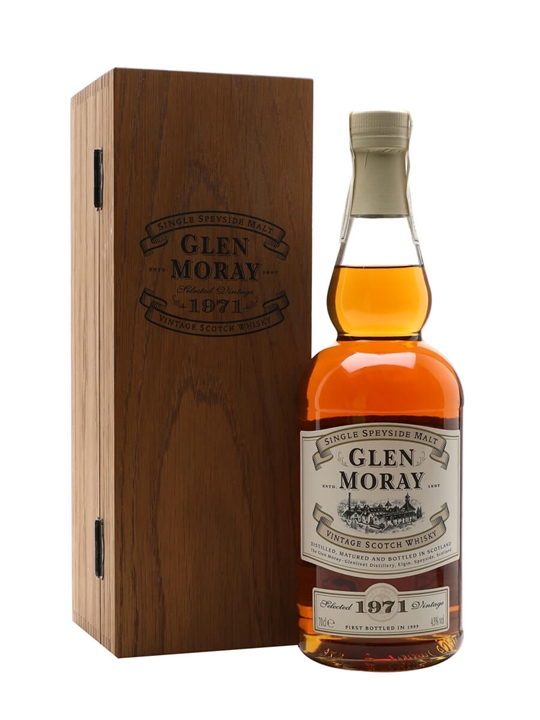

There are bottles that sit on a shelf and quietly command respect. The Glen Moray 1971 / 28 Year Old is one of them. Distilled in 1971 and left to mature for nearly three decades, this is a Speyside single malt from an era when Glen Moray operated with far less fanfare than its neighbours along the river Lossie. That relative obscurity, I'd argue, is part of the appeal. This isn't a bottle you buy for the label. You buy it because you understand what 28 years in oak actually means.
Glen Moray has long been considered an approachable, everyday Speyside — pleasant, uncomplicated, good value. But age transforms. A 28-year-old expression from this distillery is a fundamentally different proposition from the standard range. At that kind of maturity, bottled at 43% ABV, you're looking at a whisky where the wood has had decades to negotiate with the spirit. The result, with any well-managed cask of this vintage, should be something layered, softened by time, with a depth that younger expressions simply cannot replicate.
What to Expect
Speyside malts of this age tend to develop a particular character — dried stone fruits, old polished leather, beeswax, perhaps a trace of something floral that's been pressed between the pages of a book for years. The 43% bottling strength is sensible here. It's not cask strength bravado; it's a measured presentation that lets the maturity speak without the burn. For a 1971 distillation, you're tasting a snapshot of how Speyside whisky was made before the industry's enormous expansion in the late twentieth century. Smaller production, less standardisation, more personality in the spirit.
At £1,100, this is undeniably a serious purchase. But context matters. Try finding any legitimately aged single malt from the early 1970s for less than four figures — you won't. The market for vintage Speyside has moved considerably, and a 28-year-old from a lesser-hyped distillery like Glen Moray actually represents something of a value proposition compared to the eye-watering prices attached to equivalent bottlings from Macallan or Glenfiddich.
The Verdict
I've always had a soft spot for the quiet distilleries — the ones that don't shout but reward patience. This Glen Moray 1971 is exactly that kind of whisky. It carries its age with grace rather than weight. It doesn't need a famous name or a limited-edition box to justify itself. What it offers is something increasingly rare: genuine maturity from a bygone era of Scotch production, bottled without fuss at a strength that invites contemplation rather than spectacle. An 8.2 out of 10 feels right — this is a very good whisky that earns its place through substance, not hype. It loses half a mark only because, without confirmed provenance on the cask type, there's an element of the unknown. But what I tasted told me enough.
Best Served
Neat, in a tulip-shaped nosing glass, at room temperature. If you've spent this kind of money on a 28-year-old Speyside, you owe it the respect of drinking it without interference. After fifteen minutes in the glass, add three or four drops of still water — no more — and see what opens up. This is an evening whisky. No ice, no mixers, no distractions. Just the dram and your full attention.