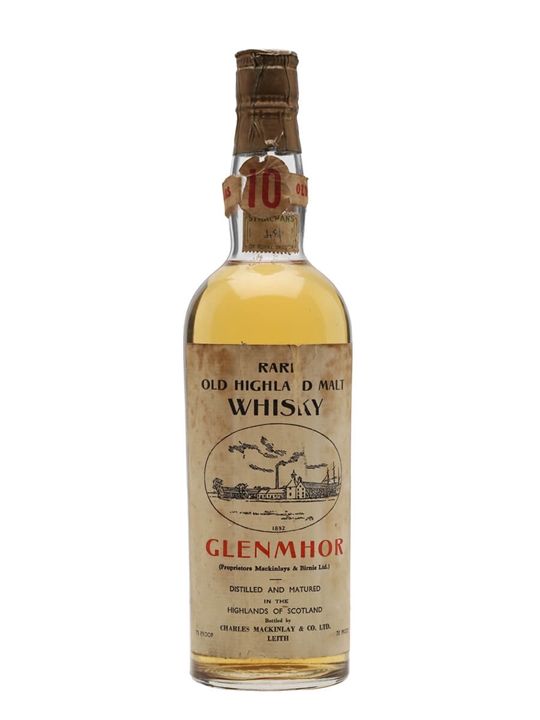

There are bottles you review, and there are bottles that stop you in your tracks. A 1960s bottling of Glen Mhor 10 Year Old belongs firmly in the latter category. Glen Mhor — the Inverness distillery that fell silent in 1983 and was demolished three years later — produced whisky for over seven decades, yet today its output is almost impossibly scarce. To hold a bottle from this era is to hold a piece of Highland whisky history that simply cannot be replicated.
At 43% ABV, this is a bottling from an age when single malts were presented with quiet confidence rather than cask-strength bravado. The 10-year age statement places this squarely in a sweet spot that the distillery was known to handle well — old enough to carry depth, young enough to retain the character of the spirit. Bottled in the 1960s, the whisky inside would have been distilled in the 1950s, a period when production methods across the Highlands remained deeply traditional, and when the character of place was stamped more firmly into the glass than perhaps at any other time in the modern era.
What to Expect
Glen Mhor was a Highland distillery through and through, and its spirit carried a profile that sat somewhere between the fruity accessibility of the gentler Speyside malts and the more robust, cereal-forward character of the northern Highlands. A 10-year-old expression from this period, bottled at a respectable 43%, should offer a window into a style of whisky-making that has largely vanished. Expect a spirit shaped by copper contact, slow fermentation, and maturation in casks that were, by today's standards, remarkably passive — allowing the distillate to speak rather than the wood.
The Verdict
I'll be direct: at £2,500, this is not a casual purchase. But for what it represents — a single malt from a lost distillery, bottled over half a century ago, in original condition — the price reflects genuine rarity rather than marketing theatre. There are plenty of bottles at this price point that trade on hype alone. This is not one of them. Glen Mhor's entire output is finite and shrinking with every bottle opened. I've scored it 8.2 out of 10, which reflects both the historical significance and the calibre of spirit Glen Mhor was capable of producing at this age. It loses a fraction only because, without confirmed provenance on the specific bottler, one must approach with an informed eye. For the collector, the historian, or the drinker who understands that some whiskies are unrepeatable, this is a serious bottle.
Best Served
If you are fortunate enough to open this, serve it neat in a tulip-shaped nosing glass at room temperature. Give it ten minutes to breathe before your first sip — spirit of this age and era deserves patience. A few drops of soft, still water may coax out further nuance, but I would begin without. This is a whisky to sit with, not to rush. Save the ice for something that needs the help.