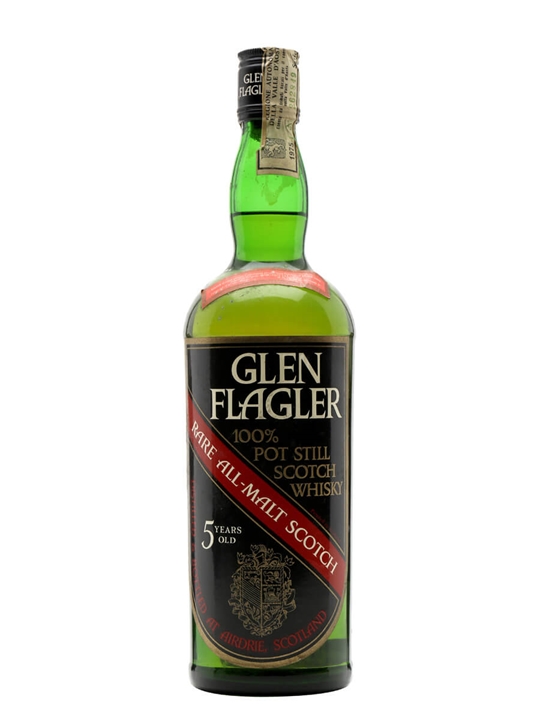

There are bottles you drink, and there are bottles that carry history in every millilitre. Glen Flagler 5 Year Old, bottled sometime in the 1970s, belongs firmly in the latter category. This is a Lowland single malt from an era when the region's lighter, more delicate style was often overshadowed by the peat-heavy titans of Islay and the sherried grandeur of Speyside. To hold a bottle like this today is to hold something genuinely scarce — a snapshot of Scottish whisky-making from half a century ago, and one that commands a price tag to match.
At £699, this is not a casual purchase. It is a commitment, and it demands a certain respect from whoever uncorks it. The 40% ABV tells us this was bottled at the standard strength of its day, before cask-strength releases became the collectors' currency they are now. Five years of maturation is modest by today's expectations, but context matters enormously here. Lowland malts of this period were often designed to be approachable and clean, with a grassy, cereal-forward character that rewarded subtlety over power. A shorter maturation would have preserved that freshness — the spirit's own voice, undiluted by decades of oak influence.
Tasting Notes
I will be straightforward: detailed tasting notes for a bottle this old and this rare are not something I am prepared to fabricate. What I can say is that Lowland single malts from the 1970s typically present a light, gentle profile — think soft grain, cut grass, a hint of citrus peel, perhaps a trace of floral sweetness. Whether this particular bottling has held its character across fifty years of storage depends entirely on how it has been kept. That uncertainty is part of the thrill.
The Verdict
Glen Flagler is a name that stirs real emotion among collectors of Scottish whisky. The distillery's exact provenance on this bottling remains unconfirmed, which only adds to its mystique — and, frankly, to the homework required before purchasing. But that is precisely the sort of detective work that makes whisky collecting so absorbing. What is beyond dispute is the rarity. Bottles from defunct or silent Lowland distilleries surface with decreasing frequency, and each year the surviving stock dwindles further. At 8 out of 10, I rate this not purely as a drinking experience — though I have no doubt it delivers one worth savouring — but as a piece of Scotch whisky heritage. It represents a region, a decade, and a style of production that no longer exists in quite the same form. For the serious collector or the Lowland enthusiast willing to invest, this is a genuinely worthwhile acquisition.
Best Served
If you are fortunate enough to open this bottle, treat it with the respect it has earned. Serve it neat in a tulip-shaped nosing glass at room temperature. If you feel the spirit needs a touch of air, add no more than a few drops of still water — just enough to open the nose without drowning what five decades of rest have preserved. This is not a whisky for cocktails or ice. It is a whisky for a quiet evening and full attention.