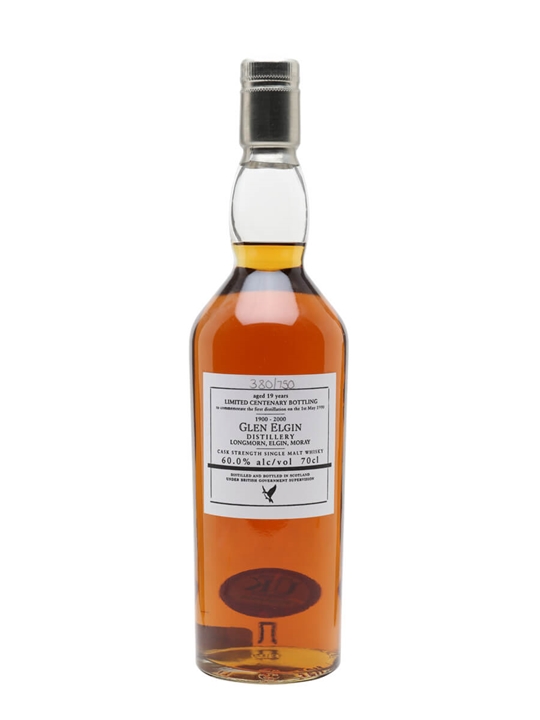

There are bottles that announce themselves quietly, and then there are bottles like the Glen Elgin 19 Year Old Centenary. At 60% ABV and nineteen years of age, this is a Speyside single malt that arrives with serious intent. The Centenary designation marks it as a commemorative release — the kind of bottling that distilleries produce when they want to put their best foot forward — and at cask strength, it offers something unvarnished and direct. I respect that.
Glen Elgin has long been one of Speyside's quieter operators. It doesn't command the name recognition of its neighbours, and much of its output has historically disappeared into blends. That relative obscurity, frankly, works in the whisky drinker's favour. When a distillery like this releases a nineteen-year-old at natural strength, you're getting something that hasn't been shaped by marketing committees. You're getting the spirit as it was found in the cask.
At 60% ABV, this is emphatically cask strength — robust, uncompromising, and built for drinkers who want to control their own experience. Nineteen years in wood is a confident age statement for Speyside: long enough to develop genuine complexity, not so long that the oak overwhelms. The combination of that maturity with full cask strength suggests a whisky with real density and weight, the kind of dram that changes character over thirty minutes in the glass as it opens up.
Tasting Notes
I'll be transparent here — I'm not publishing detailed tasting notes for this particular bottling at this time. What I can say is that Glen Elgin's house style typically leans towards a honeyed, slightly waxy Speyside character, and at this age and strength, you should expect something with genuine presence. This is not a whisky that will fade into the background.
The Verdict
At £700, the Glen Elgin 19 Year Old Centenary sits in serious territory. You are paying for age, for cask strength, and for the commemorative nature of the release. Is it justified? I think largely yes. Cask strength Speyside at nineteen years old, from a distillery that rarely releases official bottlings of this calibre, occupies a genuinely limited space in the market. You're not paying for a famous name here — you're paying for what's in the bottle, and that matters.
The 60% ABV is the real story. It tells you that nothing has been taken away. No chill filtration at this strength, no dilution to soften the edges. What you pour is what the cask delivered, and there is an honesty to that which I find increasingly rare in an era of premiumisation and packaging theatre. I'm giving this an 8.6 out of 10 — a strong score that reflects both the quality of the spirit's pedigree and the integrity of the presentation. It loses a fraction only because, at this price point, I want to see a distillery shouting from the rooftops about exactly which casks were used, and that information isn't readily available here.
Best Served
Pour it neat into a Glencairn and leave it alone for ten minutes. At 60% ABV, this whisky needs air and time before you go anywhere near it. Once it's settled, add water in small increments — a few drops at a time — until the alcohol heat recedes and the spirit opens up underneath. Cask strength Speyside at this age rewards patience. Don't rush it, and don't drown it. A half-teaspoon of water at a time is your friend here. This is an evening dram, not a casual pour.