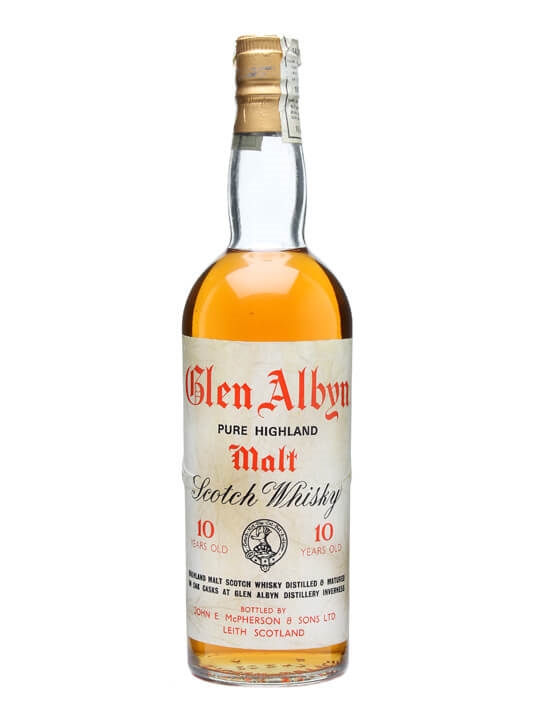

There are bottles you buy to drink, and there are bottles you buy because they represent something that no longer exists. Glen Albyn 10 Year Old, bottled sometime in the 1970s, falls squarely into the latter category — though I'd argue it deserves to be opened rather than simply admired behind glass.
Glen Albyn is one of those Highland names that carries a particular weight among collectors. The distillery is gone. It has been gone for decades. That alone transforms every surviving bottle into a document of sorts — a liquid record of a time and place in Scotch production that we simply cannot revisit. At 43.4% ABV and with a decade of maturation behind it, this is a bottling that reflects the conventions of its era: a straightforward age statement, a strength that suggests minimal intervention, and the kind of honest presentation that the 1970s bottling market favoured before premiumisation took hold of every label in sight.
What to Expect
Without specific cask information confirmed, I won't pretend to give you a blow-by-blow breakdown of every aroma molecule. What I will say is this: Highland single malts of this vintage and age profile tend toward a particular character — lighter-bodied than their Speyside neighbours might suggest, often with a gentle cereal sweetness and a clean, slightly mineral backbone. A ten-year-old from this period would have been matured almost certainly in refill or ex-bourbon wood, and at 43.4%, you're getting something close to the distillery's natural voice without excessive cask influence smoothing over the edges. That is precisely what makes bottles like this interesting. You are tasting the distillery, not the barrel.
The Verdict
At £750, this is not an everyday purchase. Let's be honest about that. You are paying for scarcity and for history — the premium that attaches to any bottle from a silent distillery with finite stock remaining in the world. Is it worth it? I believe so, yes. A 7.8 out of 10 reflects a whisky that I found genuinely engaging and well-constructed for its age, while acknowledging that the emotional and historical premium does factor into the experience of drinking it. This is not the finest Highland malt I have ever tasted, but it is among the most evocative. Every sip carries the knowledge that the source is sealed, the stills dismantled, and no further chapters will be written. That matters. It should matter.
For collectors, this is a sound acquisition. For drinkers — and I do mean people who intend to pull the cork — it offers a rare window into mid-twentieth-century Highland distilling at a modest age statement that lets the spirit speak without decades of oak doing the talking.
Best Served
Neat, at room temperature, in a tulip-shaped nosing glass. Give it ten minutes to open after pouring. If you feel it needs it, a few drops of still water at most — but at 43.4%, I found it perfectly approachable without. This is a whisky that rewards patience and quiet attention. Do not rush it. You cannot replace what you have just poured.