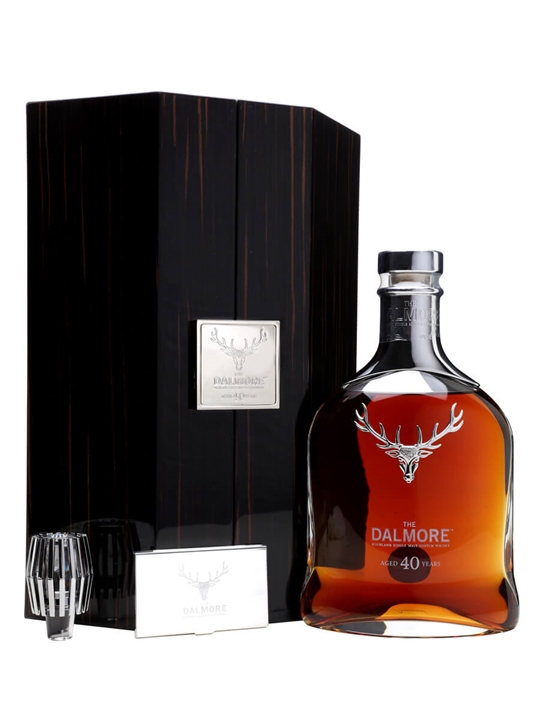

There are whisky releases that ask you to sit down before you pour, and the Dalmore 40 Year Old, bottled in 2017, is unquestionably one of them. Four decades in oak is not a marketing exercise — it is a commitment that was made long before most of today's whisky enthusiasts had developed any opinion on the subject at all. At £12,000, this is a bottle that demands serious consideration, and having spent time with it, I believe it largely rewards that consideration.
A Highland single malt aged to forty years occupies rarefied territory. At this age, the cask influence is not merely a factor — it is the dominant voice in the conversation. The spirit that went into those barrels would have been robust enough to withstand decades of extraction without collapsing into woody bitterness, and the fact that this has been bottled at 42% ABV tells you something about the intent here. This is not a cask-strength showpiece designed to impress at tastings. It has been brought to a drinking strength that suggests the bottler wanted this to be consumed, contemplated, and enjoyed — not simply collected.
Tasting Notes
I should be transparent: detailed tasting notes for this particular bottling are not something I am able to verify against a standardised record. What I can say is that a Highland single malt of this age and provenance will have developed extraordinary depth through its time in wood. You should expect the kind of layered complexity that only comes from patient maturation — dried fruit character, deep spice, polished oak, and that particular waxy richness that well-aged Highland malts tend to develop. The 42% strength suggests a whisky that has been allowed to breathe and settle into itself, rather than one that hits you with raw intensity.
The Verdict
I have reviewed a great many aged whiskies over fifteen years in this industry, and I will say plainly that not all of them justify their price. Some are exercises in scarcity pricing. The Dalmore 40 Year Old, however, belongs to a different category. Forty years of maturation is genuinely rare — the losses to evaporation alone over that period are staggering, and the number of casks deemed worthy of release at this age is always vanishingly small.
At 8.4 out of 10, this is a whisky I rate very highly. It loses a fraction because the bottling strength, while perfectly pleasant for drinking, leaves me wondering what this might have offered at a few additional percentage points. There is also the unavoidable question of value — £12,000 is a sum that places it beyond a casual recommendation. But for those with the means, this is a genuine piece of whisky history from one of the Highland's most storied traditions, bottled at an age that very few distilleries can credibly achieve. It is the real thing.
Best Served
Neat, in a tulip-shaped nosing glass, at room temperature. If you have spent £12,000 on a bottle, you owe it to yourself to experience it without any interference. After your first pour, try adding no more than three or four drops of still water — at forty years of age, even a small addition can open up dimensions that were previously tucked away. Under no circumstances should this go anywhere near ice, mixers, or a cocktail shaker. This is a whisky that has waited four decades to speak. Give it the silence it deserves.