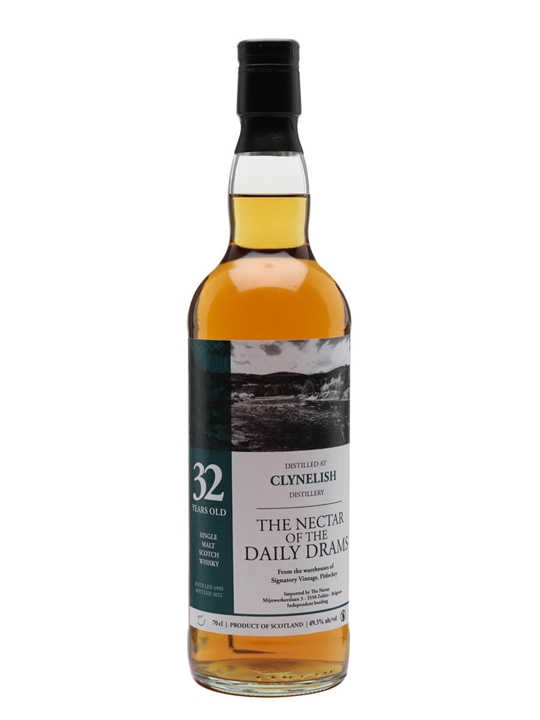

There are certain names in Scotch whisky that carry a quiet authority, and Clynelish is firmly among them. This 1990 vintage, bottled by Daily Dram at 32 years of age and a natural 49.3% ABV, is the kind of release that demands you slow down and pay attention. Independent bottlings of Clynelish at this age are increasingly scarce, and when one does surface, it tends to disappear quickly — and for good reason.
Clynelish has long occupied a peculiar position in the Highland landscape: widely admired by those who know, yet never quite achieving the household recognition of its neighbours. That relative obscurity has, paradoxically, become part of the appeal. A 32-year-old expression from 1990 puts us squarely in a period many regard as producing some of the distillery's finest spirit — laid down at a time when consistency of character was paramount and cask selection still felt like a craft rather than an algorithm.
What to Expect
At three decades in oak, you would expect a whisky to have developed considerable depth and complexity, and a Clynelish of this vintage should be no exception. The hallmarks of the distillery style — that distinctive waxy quality, coastal undertones, and a certain honeyed richness — tend to evolve beautifully with extended maturation. At 49.3%, this has been bottled at a strength that suggests confidence in the liquid; there has been no need to push it to cask strength for impact, nor water it down to make it approachable. It sits in that sweet spot where the alcohol carries flavour rather than heat.
Daily Dram have built a solid reputation for selecting casks that speak clearly of their origin, and the decision to bottle this particular cask suggests it showed something worth preserving. At 32 years old, the interaction between spirit and wood should be mature and fully integrated — this is not a young whisky dressed up by an aggressive cask, but rather the product of patience.
The Verdict
At £875, this is not an everyday purchase. But context matters. Aged Clynelish from reputable independent bottlers has become genuinely rare, and prices reflect that scarcity. For what you are getting — a single malt from a respected Highland distillery, over three decades old, bottled at natural strength from a sought-after vintage — the pricing sits within the bounds of reason for the current market. I would rate this 8.1 out of 10. It represents a compelling piece of Highland whisky history from an era we are unlikely to see repeated, and the bottling strength gives me confidence that the character has been preserved with integrity. It loses a fraction only because, without confirmed cask details, there is a small element of the unknown — but everything on paper points to a whisky of genuine quality.
Best Served
A whisky of this age and pedigree deserves to be taken neat, in a proper tulip-shaped glass, given fifteen minutes to open after pouring. If after the first few sips you feel it needs it, add no more than a few drops of still water at room temperature — this can sometimes unlock additional layers in older malts without diminishing the texture. A Highball would be a waste. This is a fireside whisky, one for an evening when you have nowhere else to be.