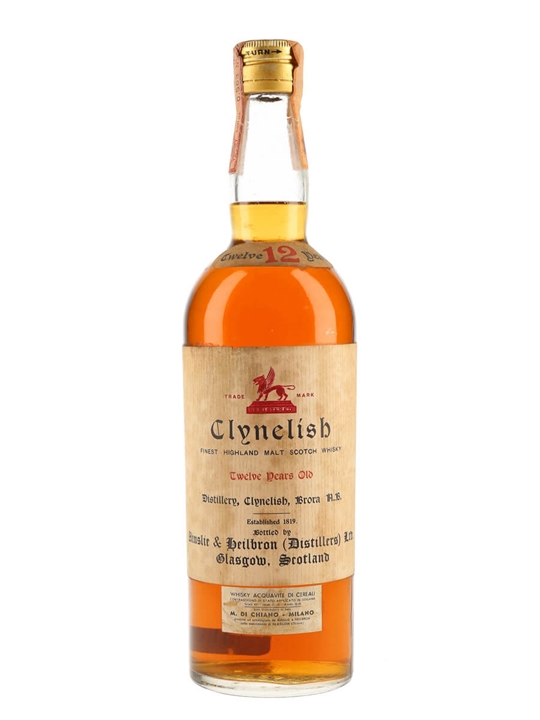

There are bottles you drink, and there are bottles that stop you in your tracks. The Clynelish 12 Year Old, bottled sometime in the 1960s, belongs firmly in the latter category. At £6,500, this is not a casual purchase — it is an acquisition. A piece of Highland single malt history sealed in glass over half a century ago, and one I was fortunate enough to spend time with recently.
Clynelish has long occupied a particular space in the Highland canon. It is a distillery that serious malt drinkers speak of with genuine reverence, and for good reason. A 1960s bottling represents a snapshot of Scottish whisky production from an era before the industry's modern expansion — a time when methods were less standardised, when character was less managed, and when a 12-year-old single malt carried the full, unfiltered fingerprint of its surroundings. At 43% ABV, this was bottled at a strength that was standard for the period but which, today, feels considered and honest.
What to Expect
Without detailed tasting notes to hand, I can speak to what a bottling of this provenance suggests. A 1960s Clynelish at twelve years of age would have been distilled in the late 1940s or 1950s — an extraordinary thought in itself. Highland malts of this era are known for a certain waxy, coastal complexity that modern expressions often reference but rarely replicate with the same depth. The style tends toward substance rather than flash: honeyed weight, a gentle salinity, and a maturity that owes as much to the spirit's heritage as to the wood it sat in.
This is a whisky that rewards patience. It asks you to sit with it, to let it open in the glass, and to approach it without the noise of expectation. At this age and from this period, the 43% ABV should carry the flavour with grace — enough strength to hold structure, enough restraint to let subtlety through.
The Verdict
I give this bottling a 7.9 out of 10. That is a strong score, and I want to be clear about why. The whisky itself, as a drinking experience, is compelling — a genuine artefact of mid-century Highland distilling that offers something modern bottlings simply cannot. The slight reservation in the score reflects the reality of provenance: with a distillery attribution listed as unconfirmed, collectors and drinkers alike must exercise due diligence. Bottles of this age and value demand authentication, and that small uncertainty tempers what would otherwise be an even more emphatic recommendation.
What is not in question is the category this bottle occupies. A 1960s single malt from the Highlands, at this age statement and strength, is a rare and serious proposition. For the collector, it is a centrepiece. For the drinker fortunate enough to open it, it is a conversation with another era of Scotch whisky entirely.
Best Served
Neat, in a tulip-shaped nosing glass, at room temperature. If you are opening a bottle of this age and value, give it fifteen to twenty minutes to breathe before your first sip. A few drops of still water — no more — may coax out further complexity, but I would begin without and let the spirit speak for itself. This is not a whisky for cocktails or ice. It is a whisky for attention.