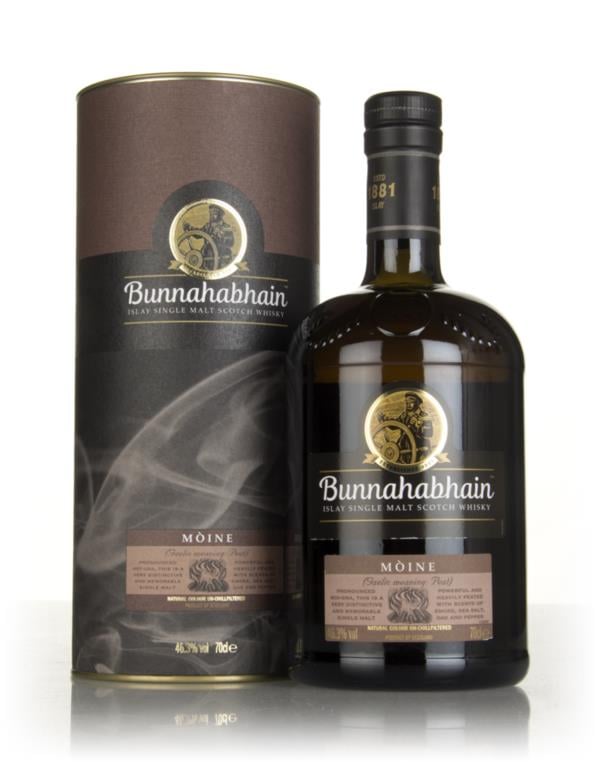
Bunnahabhain has produced peated spirit alongside its unpeated standard for decades, originally to supply blenders who required an Islay smoke component. Since the early 2000s, under the ownership of Distell and later Distell's parent Heineken, the peated make has been released as a single malt under the name Moine — Scots Gaelic for peat. Toiteach, meaning smoky, has filled a similar role, but Moine is the distillery's more committed peated statement, typically bottled at higher strengths and without the usual softening.
The peat specification for Moine sits in the heavily peated range familiar from other Islay distilleries, but the spirit retains Bunnahabhain's house character: nutty, coastal, and a little oilier than its southern neighbours. The cask strength release strips away the final restraint, bottling the whisky at natural strength without chill filtration or colouring. The result is a fuller, more textured expression of the distillery's smoke side, and one that answers any lingering doubt about whether Bunnahabhain belongs among the serious peated Islays.
The nose offers wood smoke and salted lemon, with tarred rope, vanilla oil and a damp coastal air. The palate is dense: peat, sea salt, honeyed barley and green olive brine, the oily weight of the spirit carrying the smoke rather than competing with it. The finish is long and saline, closing on ash, kipper and a slow mineral breath.
It is the counterpart to the distillery's unpeated flagship — a reminder that Bunnahabhain's remote northern spot produces whisky of considerable range, and that its peated side, presented honestly and without reduction, holds its own in any Islay company.