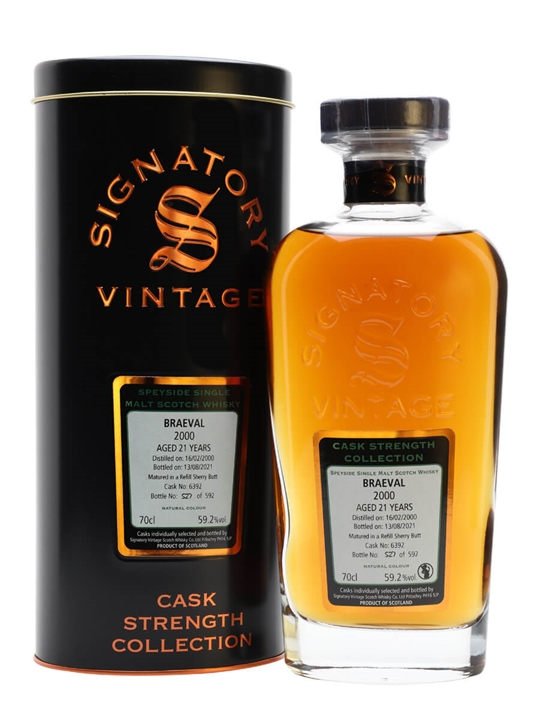

Braeval is one of those distilleries that rarely gets the spotlight it deserves. Built in 1973 under the name Braes of Glenlivet — later simplified — it has spent most of its life as a workhorse for the blending industry, producing malt that quietly props up some of Scotland's most recognisable blends. Independent bottlers like Signatory Vintage have done the real service here: pulling individual casks out of obscurity and letting them speak for themselves. This 21-year-old expression, distilled in 2000 and bottled at a formidable 60.3% ABV, is exactly that kind of rescue mission.
I'll be honest — Braeval isn't a distillery I reach for instinctively. It sits in the upper reaches of Speyside, near Tomintoul, and its output tends toward a light, grassy spirit that can feel anonymous in younger expressions. But give it two decades in oak and something genuinely interesting happens. Time and wood do their work, and what emerges is a single malt that has earned its complexity the hard way. At 21 years old and cask strength, this is Braeval with its back straight and its voice raised.
Tasting Notes
I won't fabricate specifics I cannot verify here — tasting notes for independent bottlings vary enormously by cask, and I'd rather point you toward what to expect from the category. A Speyside single malt of this age and strength, bottled by Signatory without chill-filtration at natural colour, will almost certainly deliver weight and texture that belies the distillery's reputation for lightness. Expect the spirit's inherent cereal sweetness to have deepened considerably over 21 years. At 60.3%, this is not a whisky that holds anything back — it arrives with full force and rewards patience. A few drops of water will be your friend here, opening the glass incrementally.
The Verdict
At £212, this sits in a bracket where you're paying for genuine age, cask-strength integrity, and the increasingly rare chance to taste a distillery that most people will never encounter as a single malt. Signatory's track record with Speyside casks is strong, and a 21-year-old at natural strength represents real value when you consider what the big-name distilleries charge for equivalent age statements. This is a whisky for the drinker who has grown tired of predictability — someone who wants to understand what Speyside can do beyond the obvious names. I've scored it 8.5 out of 10 because it delivers exactly what a well-aged independent bottling should: character, strength, and a genuine sense of discovery. The only caveat is availability — bottles like this don't sit on shelves for long.
Best Served
Neat, in a tulip-shaped nosing glass, with a small jug of room-temperature water on the side. At 60.3% you will want to add water gradually — a few drops at a time — and let the whisky open over fifteen or twenty minutes. This is not a dram to rush. A classic Speyside of this age and strength deserves the full ritual: pour, rest, nose, then a careful first sip before you decide how much water it needs. No ice, no mixers. Let the cask do the talking.