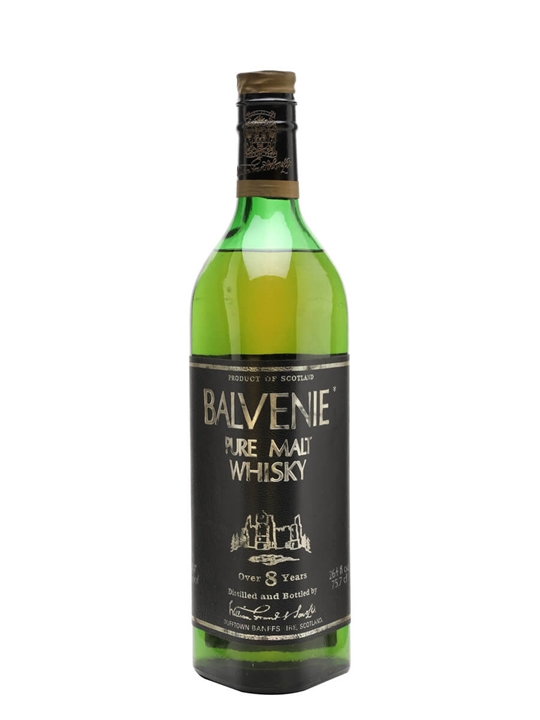

There are bottles you drink, and there are bottles you sit with. The Balvenie 8 Year Old, bottled sometime in the 1970s, belongs firmly in the latter category. This is a piece of Speyside history in glass — a snapshot of how single malt was made and presented before the whisky boom reshaped the industry. At £500, you are not simply buying a dram. You are buying a time capsule.
What strikes me first about this bottle is its context. An 8-year-old single malt bottled at 40% ABV in the 1970s tells you something important about the era: age statements were honest markers, not marketing tools, and the spirit inside was expected to speak for itself. Speyside malts of this period were built on a foundation of quality cask selection and unhurried maturation in a cooler Scottish climate than we see today. The barley was different. The water was the same. The approach was less calculated, more instinctive.
At eight years, you would expect a Speyside malt of this vintage to sit comfortably in the lighter, more honeyed register — orchard fruit, cereal sweetness, perhaps a gentle malty backbone that was characteristic of the region's output during that decade. The 40% bottling strength was standard for the time, and while modern palates might wish for a few extra degrees, it was the house style. This is whisky as it was meant to be consumed: approachable, unshowy, and confident enough not to need cask strength theatrics.
The Verdict
I score this 8.3 out of 10, and I want to be clear about why. This is not a score based on rarity alone — I have little patience for collectors who treat whisky like stocks and shares. The score reflects what this bottle represents: a genuine artefact from a period when Speyside single malt was produced with a simplicity and directness that the modern market has largely moved away from. The fact that it has survived intact for over fifty years only adds to its character. Every decade in glass changes a whisky, and this one has had five of them to settle into itself.
At £500, this sits at the upper end of what I would consider fair for a vintage bottling of this age statement. You are paying for provenance, scarcity, and the privilege of tasting something that no longer exists in production. If you are a serious Speyside enthusiast, this is the kind of bottle that fills a gap in your understanding of how the region's character has evolved. If you are simply curious, there are more affordable ways to explore — but none quite like this.
Best Served
Neat, at room temperature, in a tulip glass. Give it ten minutes to open after pouring. A whisky of this age and vintage deserves the patience. If you feel it needs it, a few drops of still water — no more — to see what fifty years in the bottle have done to the structure. Do not rush this one. Do not ice it. And for heaven's sake, do not mix it.