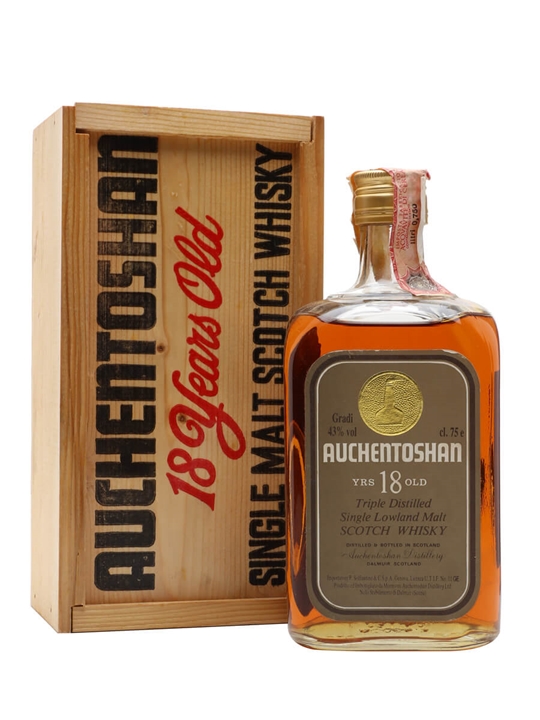

There are bottles you drink, and there are bottles you sit with. The Auchentoshan 18 Year Old from the 1980s bottling era falls firmly into the latter category. At £399, this is not an impulse purchase — it is an investment in a particular moment in Lowland whisky-making, a window into how Auchentoshan presented itself before the modern craft boom reshaped expectations of what Scottish single malt could be.
Auchentoshan has long stood apart from its Highland and Speyside neighbours. Situated on the outskirts of Glasgow, it remains one of the few Scottish distilleries committed to triple distillation — a method more commonly associated with Irish whiskey. The result, broadly speaking, is a lighter, cleaner spirit, one that rewards patience in maturation rather than brute cask influence. An 18-year-old expression from this distillery, bottled in the 1980s, represents a compelling intersection of that house style with the oak character that nearly two decades of ageing provides.
What to Expect
Without specific tasting notes to hand for this particular bottling, I can speak to the character of Auchentoshan at this age with some confidence. The triple-distilled spirit, given 18 years to develop, typically yields something elegant rather than powerful. At 43% ABV — a respectable strength for the era — you should expect a whisky that carries itself with a certain quiet authority. Lowland malts of this vintage tend to lean towards cereal sweetness, gentle citrus, and a soft, rounded oak influence. The 1980s bottling era often delivered whiskies that were less heavily sherried than what came later, favouring subtlety over drama.
This is a whisky that asks you to pay attention. It will not shout at you from across the room. It will, however, reward anyone willing to sit with it and let it unfold at its own pace.
The Verdict
I rate this Auchentoshan 18 Year Old at 8.1 out of 10. The score reflects both what the whisky represents and the quality of the distillery's output during this period. Auchentoshan has always been somewhat undervalued by collectors chasing Islay peat or Speyside sherry bombs, and that relative obscurity works in the buyer's favour here. At £399, you are paying for genuine age, a discontinued bottling presentation, and a style of Lowland whisky-making that feels increasingly rare in today's market. It loses a point or two because the 43% strength, while perfectly acceptable, leaves you wondering what this spirit might have been at cask strength — and because the Lowland profile, however well-executed, will not satisfy those who want intensity above all else. But for what it is — a mature, thoughtful, well-made single malt from a distillery that deserves more recognition — it earns its mark comfortably.
Best Served
Pour this one neat in a Glencairn glass at room temperature. If the ABV feels tight on the first sip, add no more than a few drops of still water — just enough to open the nose without diluting the texture. This is not a whisky for cocktails or ice. It has earned the right to be taken seriously, and the best way to honour a bottle from this era is to give it your full attention. A quiet evening, no distractions, perhaps a square of dark chocolate on the side if you must. Let the glass sit for five minutes before your first nosing. Patience is not optional here — it is the point.