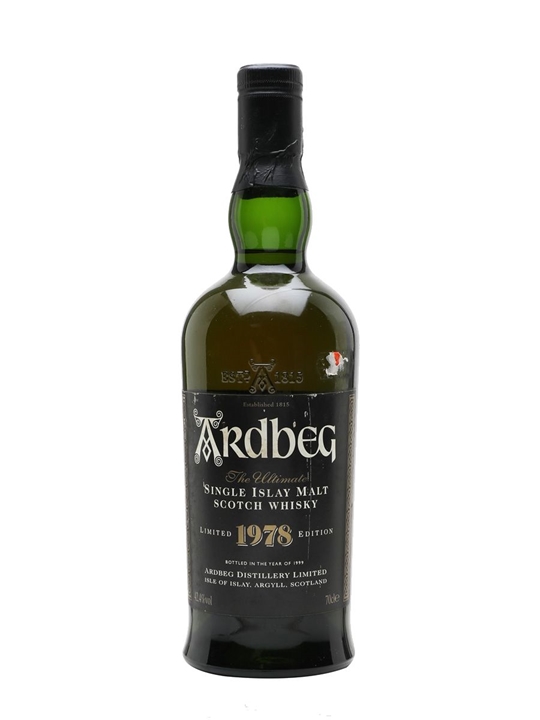

There are bottles you buy to drink, and there are bottles you buy because they represent a moment in time. The Ardbeg 1978, bottled in 1999, is firmly in the latter category — though I'd argue it deserves to be opened rather than merely admired behind glass. This is Ardbeg from what collectors often call the 'silent years,' when the distillery was mothballed or operating intermittently, making any surviving stock from this era genuinely scarce.
At 42.4% ABV, this sits just above the standard 40% floor, which tells us something about the bottling philosophy of the era. This wasn't cask strength bravado; it was a measured, considered release. Twenty-one years in cask — distilled in 1978, bottled in 1999 — would have allowed significant interaction between spirit and wood, and at this strength, you'd expect a whisky that has settled into itself completely. The edges rounded, the peat transformed from raw smoke into something altogether more complex and integrated.
What makes any Ardbeg from this period particularly compelling is context. The distillery's history through the late 1970s, 1980s, and into the 1990s was turbulent, to put it mildly. Production was inconsistent, ownership changed hands, and for stretches the stills sat cold. That scarcity isn't manufactured — it's genuine. When Glenmorangie plc took the reins in 1997 and began the revival that gave us the Ardbeg we know today, bottles like this 1978 vintage became artefacts of the old regime. You're not just drinking whisky; you're drinking a piece of Islay's industrial history.
Tasting Notes
I won't fabricate specifics where precision demands honesty — tasting notes for a bottle at this age and rarity deserve to be experienced firsthand rather than recited secondhand. What I will say is this: expect the hallmarks of old Ardbeg, where peat is present but no longer shouting. Two decades in oak will have introduced layers that younger expressions simply cannot replicate. The ABV suggests an approachable, almost gentle delivery, but don't mistake gentleness for simplicity. Aged Islay malts at this strength have a way of unfolding slowly, rewarding patience.
The Verdict
At £1,800, this is not an everyday purchase — nor should it be. But within the context of collectible Islay single malts, and particularly within the market for pre-revival Ardbeg, it represents something real. This isn't a limited-edition marketing exercise or a flashy cask finish designed to generate Instagram posts. It's a single malt from a specific place and a specific time, bottled before the distillery became the global phenomenon it is today. For the serious Ardbeg collector, or for anyone who wants to understand what this distillery was before the world caught on, the 1978 vintage is as close to essential as it gets. I'm giving it 8 out of 10 — a score that reflects both its undeniable quality and its place in the broader Ardbeg story. The missing points? Only because, at this price, I'd want to sit with it over several sessions before calling it flawless.
Best Served
Neat, and at room temperature. Pour it, then walk away for ten minutes. A whisky that spent twenty-one years in cask has earned the right to breathe in your glass. If you feel compelled, a few drops of still water — no more — may open things up, but start without. This is not a whisky for cocktails, highballs, or ice. It is a whisky for a quiet room, an unhurried evening, and your full attention.