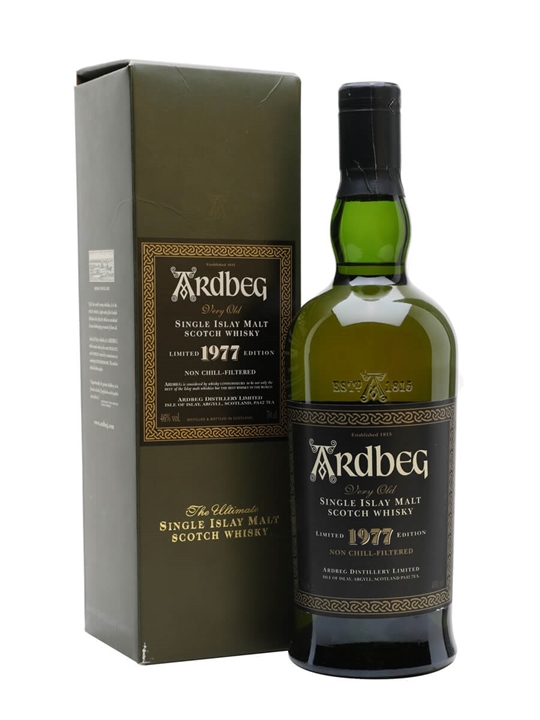

There are bottles that sit behind glass in specialist retailers, and then there are bottles that stop you mid-stride. The Ardbeg 1977, bottled sometime in the early 2000s, is firmly in the latter category. Distilled during a period when Ardbeg's future was anything but certain — the distillery endured closures and ownership upheaval throughout the late seventies and eighties — this is whisky from an era we simply cannot revisit. At 46% ABV and carrying a £1,500 price tag, it demands serious consideration before you commit. Having spent time with this bottle, I believe it rewards that commitment handsomely.
Ardbeg needs little introduction to anyone with even a passing interest in Islay malts. The distillery, perched on the southern coast of the island, has built its reputation on heavily peated spirit with a maritime backbone. What makes vintages from 1977 particularly compelling is context. Production volumes were low, the distillery's operations were intermittent, and the spirit that survived into cask represents a snapshot of craft under constraint. By the time this was bottled in the 2000s, it had spent roughly two and a half decades maturing — though no official age statement is declared. That patience shows.
What to Expect
Without detailing specific tasting notes here, I can speak to character. This is Islay through and through, but aged Islay — the kind where decades of oak contact have tempered the peat smoke into something more integrated, more contemplative. Expect the distillery's signature coastal influence, but softened and deepened by time. At 46%, it carries enough strength to deliver complexity without the burn that higher cask-strength releases sometimes bring. This is not a young Ardbeg shouting for attention. It is an old one that knows exactly what it has to say.
The bottling strength is worth noting. Forty-six percent suggests a considered approach — enough dilution for accessibility, enough backbone for structure. For a whisky of this age and provenance, it strikes a sensible balance that lets you appreciate what time has done to the spirit without fighting through heat.
The Verdict
At £1,500, this is not an impulse purchase, nor should it be. But within the world of vintage Ardbeg — where certain releases now trade for multiples of this figure — I would argue it represents genuine value for what you are getting: a piece of Islay history from a distillery that nearly disappeared. I have given this an 8 out of 10. It loses marks only because, at this price point, you are competing against an extraordinary field of aged single malts from across Scotland. But as a statement of what Ardbeg was, and what survived from that uncertain period, it is a bottle I am glad to have opened rather than left sealed on a shelf. Whisky exists to be drunk, and this one justifies every pour.
Best Served
Neat, in a tulip glass, at room temperature. If you feel the need, a few drops of still water will open things up — but give it fifteen minutes in the glass first. A whisky that has waited this long deserves the same courtesy from you. There is absolutely no place for ice here. Let the decades of maturation speak without interference.