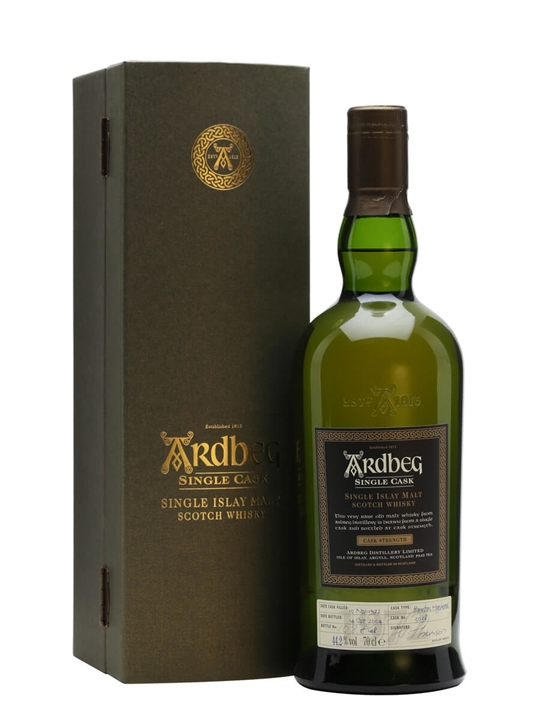

There are bottles you review, and there are bottles that stop you mid-pour. Ardbeg 1972 Cask #3038 is firmly in the latter category. A single cask Islay single malt drawn from a 1972 vintage, bottled at a restrained 44.2% ABV — this is the kind of whisky that commands silence when you crack the seal. At £7,500, it sits squarely in collector territory, but make no mistake: this is a dram meant to be drunk, not displayed.
The 1972 vintage from Ardbeg occupies near-mythical status among Islay devotees, and for good reason. The early 1970s were a transitional period for the distillery, and casks from that era are now vanishingly rare. Cask #3038 is an independent single cask release — the distillery source is listed without official confirmation, as is common with older independent bottlings — but the character is unmistakable. This is Islay through and through.
What strikes me most about this whisky is its composure. At 44.2%, it has been bottled at a strength that suggests decades of slow, patient maturation. There is no cask-strength aggression here, no need to prove anything. The ABV tells its own story: this spirit has had a very long conversation with oak, and what remains is something quietly assured. For a whisky of this age and provenance, that poise is exactly what you want.
Tasting Notes
I will not fabricate specific notes where my records are incomplete. What I can say is this: Ardbeg from this era tends toward a profile where the famous Islay peat has been tempered by time — decades in wood shift the balance from coastal fire toward something more integrated, more layered. Expect the kind of complexity that only genuine age can deliver. At 44.2%, this should be approachable without water, though a single drop may open further dimensions. I would encourage any owner of this bottle to take their time and draw their own conclusions.
The Verdict
An 8.2 out of 10 from me. That is a strong score, and I give it with confidence. The provenance is exceptional — a 1972 single cask Islay malt is a genuine piece of whisky history. The bottling strength is intelligent, suggesting a bottler who understood what they had and respected it. Where I hold back slightly is the uncertainty around official distillery confirmation, which matters at this price point. Collectors and serious drinkers will understand the nuance of independent bottlings, but for £7,500, full traceability would push this into the highest tier. That said, what is in the glass speaks for itself. This is a whisky that earns its price through sheer rarity and the unmistakable weight of time.
Best Served
Neat, and only neat. Pour it into a proper tulip-shaped nosing glass — a Glencairn will do nicely — and let it sit for ten minutes before you go anywhere near it. At 44.2%, it does not need water, though I would never fault anyone for adding a few drops to a whisky of this age purely out of curiosity. Do not chill it, do not mix it, and for the love of all that is good, do not rush it. This is a Saturday evening dram with no distractions, a comfortable chair, and nowhere to be.