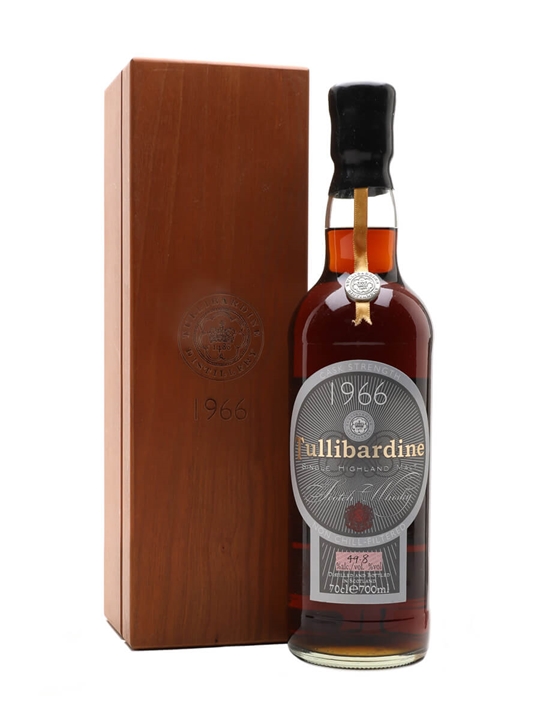

There are bottles that sit on a shelf and quietly demand your attention. Tullibardine 1966 Cask #1112 is one of them. A single sherry cask Highland whisky distilled over half a century ago, bottled at a natural 49.8% ABV — this is the kind of release that stops you mid-conversation. I've been fortunate enough to spend time with this dram, and it deserves a considered account.
Tullibardine has never been the loudest name in the Highlands. It sits in the Perthshire countryside, a distillery that has changed hands more than once and spent years in relative quiet. But that silence, I'd argue, is part of its character. The whisky has always carried a gentle, malt-forward disposition — a house style that rewards patience. And patience is precisely what Cask #1112 represents. A 1966 vintage, drawn from a single sherry cask, speaks to an era of production we simply cannot replicate today. The sherry wood available in the mid-twentieth century was markedly different from what cooperages supply now, and that matters enormously in a whisky of this age.
At 49.8%, this has been bottled at what appears to be natural cask strength, or very close to it — a decision I wholeheartedly support. Diluting a whisky of this provenance to 40% would be an act of vandalism. That strength gives you the full architecture of what decades in sherry oak can achieve: concentration without aggression, weight without clumsiness.
What to Expect
A Highland malt of this vintage and cask type occupies a very specific space. You should expect the influence of old-style sherry wood to be profound — dried fruits, dark chocolate, polished leather, old library books. These are the signatures of properly seasoned European oak that has had decades to work its way through the spirit. The Highland character beneath will likely present as honeyed malt, gentle cereal sweetness, perhaps a thread of beeswax. At nearly 50%, there will be structure and presence on the palate, but a whisky that has spent this long in wood tends to carry its strength with remarkable composure.
The Verdict
At £2,000, this is not an everyday purchase — nor should it be. This is a bottle for the collector who understands what a 1966 vintage from a single sherry cask actually represents. It is a piece of history, quite literally. The spirit inside was distilled in an era when production methods, raw materials, and cask sourcing were fundamentally different from today's standards. You cannot recreate this whisky. You can only find the remaining bottles.
I'm scoring Tullibardine 1966 Cask #1112 at 7.8 out of 10. It is a genuinely impressive whisky — the kind of dram that rewards slow, attentive drinking and gives you something new with every return to the glass. The sherry cask influence at this age is a rare thing to encounter, and the natural strength bottling is exactly right. Where I hold back slightly is on value: £2,000 is a significant outlay, and in a market crowded with aged Highland single malts from better-known distilleries, Tullibardine carries less name recognition. That said, for those who know, that relative obscurity is precisely the appeal. You are buying the whisky, not the brand.
Best Served
Neat, in a tulip glass, with twenty minutes of breathing time. If you must add water, a few drops only — this whisky has earned the right to speak at full volume. A dram of this age and complexity is not for mixing. Sit with it. Let it open. There is no rush when you have fifty-odd years of patience already in the glass.