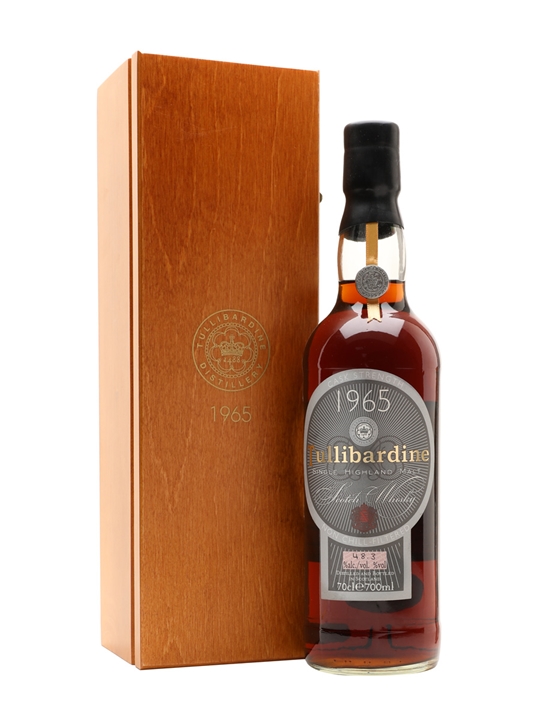

There are bottles that sit on a shelf and quietly demand your attention. Tullibardine 1965, Cask #949, is one of them. A single sherry cask Highland whisky carrying a 1965 vintage — the kind of statement piece that stops you mid-conversation. At 48.3% ABV, it has been bottled at a strength that suggests confidence in the liquid rather than any need to dilute what the cask has given it. At £1,750, this is not an everyday pour. It is not trying to be.
Tullibardine has long occupied an unusual position among Highland distilleries — respected by those who know it, overlooked by those chasing louder names. A 1965 vintage from a single sherry cask is the kind of release that reminds you why patience matters in this industry. Whatever the precise duration of maturation, a whisky carrying that vintage has had decades of conversation with oak, and sherry-seasoned oak at that. The result, at this ABV, should deliver considerable depth without the heavy-handed sweetness that plagues lesser sherry cask expressions.
What to Expect
With a 1965 vintage and sherry cask influence, you are looking at a whisky that should sit firmly in the territory of dried fruit, old polished wood, and the kind of savoury complexity that only serious time in good oak can produce. At 48.3%, there is enough strength to carry those flavours with authority, but not so much that it overwhelms. Highland character — that clean, slightly honeyed backbone — should provide structure beneath whatever the sherry cask has layered on top. This is not a whisky that shouts. It is one that unfolds.
The Verdict
I have given this an 8.1 out of 10. That is a strong score, and I want to be clear about why. A single cask whisky of this vintage, from this distillery, bottled at natural strength — it ticks the boxes that matter to me as someone who values provenance and restraint over marketing noise. The sherry cask influence at this age should be deeply integrated rather than simply decorative, and 48.3% is a bottling strength that tells me someone tasted this and decided it was ready as it was. The price is significant, but for a whisky of this calibre and rarity, it is not unreasonable. You are paying for decades of maturation and the irreplaceable nature of a single cask — once it is gone, it is gone. What keeps this from a higher score is simply the reality that at this price point, I hold bottles to an exacting standard, and there are vintages from other Highland distilleries that have set a formidable benchmark.
Best Served
Neat, in a tulip glass, with twenty minutes of breathing time. A whisky of this age and complexity deserves the space to open up on its own terms. If after the first few sips you feel it needs it, add no more than a few drops of room-temperature water — but I suspect you will find it does not ask for much. This is a whisky for a quiet evening, unhurried, with nothing competing for your attention.