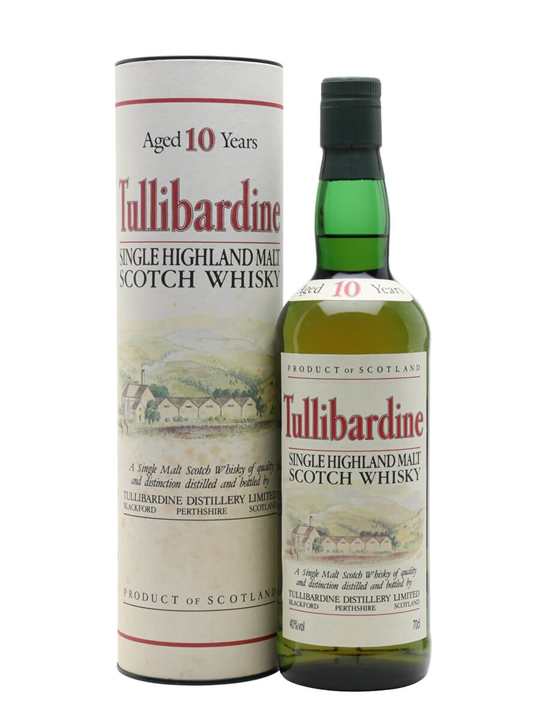

There are bottles that represent a moment in time, and the Tullibardine 10 Year Old from the 1980s is precisely that. Sitting with this Highland single malt, I find myself holding a piece of Scotch whisky history — a snapshot of a distillery and an era that operated under very different commercial pressures than today's craft-forward market. At 40% ABV and with a decade of maturation behind it, this is a whisky that was bottled to be approachable, yet it carries a quiet confidence that rewards attention.
Tullibardine has always been something of an understated name in the Highland canon. Situated in Blackford, Perthshire, the distillery has passed through several hands over the decades, and bottles from the 1980s come from a period when production methods and cask selection followed a distinctly different philosophy. The result is a spirit that feels of its time — less engineered, perhaps less polished by modern standards, but honest in a way that many contemporary releases struggle to replicate. There is a straightforwardness to 1980s Highland bottlings that I find increasingly appealing as the industry trends toward ever more elaborate finishes and limited editions.
What to Expect
At ten years old and bottled at the standard 40%, this Tullibardine was never intended to be a showstopper. It sits in that category of everyday Highland malts that were designed to be reliable and pleasant — the kind of bottle you might have found behind a good hotel bar in Edinburgh or Glasgow during that period. But age has a way of adding intrigue to the ordinary. The fact that this liquid has been resting in glass for roughly four decades means the spirit you pour today is unchanged from the day it was sealed. That continuity is part of the appeal. You are tasting exactly what a whisky drinker in 1985 would have tasted, and that kind of direct connection to the past is something no amount of marketing can manufacture.
Highland malts from this era tend toward a gentle, cereal-forward profile with a clean sweetness. At 40% ABV, expect a lighter body — this is not a whisky that will overpower you, but rather one that invites you to sit with it. The lower bottling strength, standard practice at the time, means the edges are softened and the spirit is easy to approach, even for those still finding their way through Scotch.
The Verdict
At £150, this bottle occupies interesting territory. You are paying for rarity and provenance rather than cask strength intensity or a prestigious age statement. For collectors and enthusiasts who appreciate the historical dimension of whisky, it represents fair value — 1980s single malts from lesser-known Highland distilleries are becoming harder to source with each passing year, and prices will only move in one direction. As a drinking experience, it offers something that modern Tullibardine releases cannot: an unfiltered look at what this distillery was producing before the recent revival era. I score it 7.7 out of 10 — a solid, characterful Highland malt with genuine historical interest that edges it above its modest specification on paper. It is not a whisky that shouts, but it has something to say if you are willing to listen.
Best Served
Pour this one neat at room temperature and give it a few minutes in the glass. A whisky of this age and bottling strength does not need dilution — the 40% ABV is already gentle enough that every nuance will present itself without interference. If you feel the need, a few drops of still water at most will open things slightly, but I would resist the temptation to add ice. This is a whisky best enjoyed slowly, preferably in quiet company, where you can appreciate the rare pleasure of tasting the past exactly as it was.