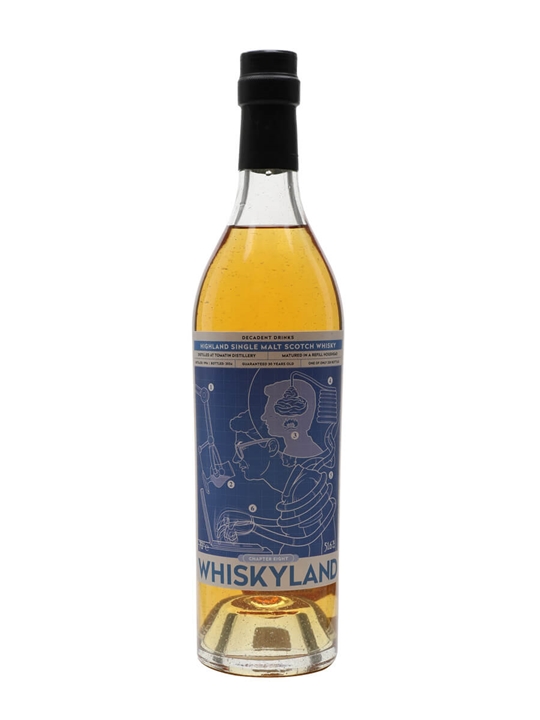
There is something quietly thrilling about a whisky that has spent three decades in oak. Not every cask survives that long with grace — some turn bitter, woody, tannic beyond redemption. But when it works, when the spirit and the wood have found their balance over thirty years, you get something that no amount of clever finishing or marketing can replicate. The Tomatin 1994, bottled as Chapter Eight of the Whiskyland series, is one of those rare successes.
Let me be upfront: this is an independent bottling, and the distillery origin, while suggested by the name, is not officially confirmed. What I can tell you is that this is a Highland-style malt — the label classes it as Speyside, which places it in that fertile overlap where Highland character meets Speyside refinement. At 30 years old and bottled at a robust 51.6% ABV, someone made the wise decision to leave this at cask strength rather than diluting it down to a polite 43%. That choice alone tells you the bottlers had confidence in what was inside.
Tasting Notes
I will not fabricate specifics where my notes would be speculation. What I will say is this: a whisky of this age and strength, drawn from what appears to be a Highland or Speyside distillation, carries a certain expectation. You should anticipate the deep, concentrated character that only comes with extended maturation — the kind of weight and complexity that sits on the tongue and evolves over minutes, not seconds. At 51.6%, there is power here, but three decades of cask interaction will have smoothed the raw edges considerably. This is not a young spirit shouting for attention. It is a whisky that has earned its composure.
The Verdict
At £476, this is not an impulse purchase, nor should it be. But context matters. Thirty-year-old cask strength single malts from reputable independent bottlers are not getting cheaper. The Whiskyland series has built a track record of selecting casks with genuine character rather than simply trading on age statements, and Chapter Eight continues that standard. I rate this 8.7 out of 10 — a score that reflects both the quality of what is in the glass and the integrity of the bottling. The decision to present this at natural strength, without chill filtration or artificial colouring, is exactly what serious whisky drinkers want from a release like this. It respects the liquid and it respects the buyer.
Is it worth the money? If you are the kind of drinker who appreciates the difference between a whisky that has genuinely matured for thirty years and one that merely carries the age statement, then yes. This is the real thing — unhurried, uncompromised, and bottled with the restraint that old whisky demands.
Best Served
Neat, in a tulip-shaped nosing glass, at room temperature. Give it ten minutes to open before your first sip. If the cask strength feels assertive, add no more than a few drops of still water — you will find the whisky unfolds rather than diminishes. This is not a cocktail malt, and frankly, putting thirty years of maturation into a Highball would be a waste. Take your time with it. It took three decades to get here; it deserves at least an evening of your attention.