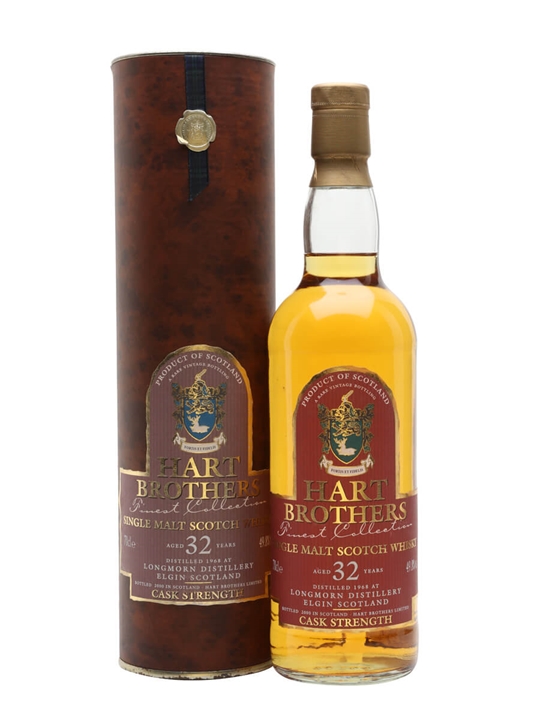

There are bottles that sit behind glass in auction houses and specialist retailers, and there are bottles that demand to be opened. The Longmorn 1968, bottled by Hart Brothers at 32 years of age, is emphatically the latter. Distilled in an era when Speyside was still working largely with coal-fired stills and worm tub condensers, this is whisky from a production landscape that no longer exists. At 49.8% ABV — just a hair beneath cask strength after three decades in oak — this bottling has retained a remarkable vitality that speaks to exceptional cask selection by the Hart Brothers team.
Longmorn has long been one of Speyside's most underrated distilleries. Those of us who have followed single malts for any length of time know that it was a cornerstone of blenders' inventories throughout the twentieth century, prized for its richness and weight — qualities that set it apart from lighter Speyside neighbours. A 1968 vintage places this whisky's distillation firmly in the pre-modernisation period, and that matters. The character of spirit produced in that era carried a density and complexity that contemporary make, however excellent, rarely replicates.
Hart Brothers, the Glasgow-based independent bottler, have built their reputation on selecting casks that are allowed to speak for themselves — no chill-filtration, no added colour. For a whisky of this age, that philosophy is exactly right. Thirty-two years is a long conversation between spirit and wood, and any heavy-handed intervention at bottling would only muddy the dialogue. The fact that this was bottled at 49.8% ABV after more than three decades suggests a cask with real integrity — one that gave generously without overwhelming the distillery character beneath.
At £2,250, this is unambiguously a serious purchase. But context matters. Longmorn official bottlings of comparable age are increasingly scarce, and independent bottlings from the late 1960s are the kind of stock that simply cannot be replaced. The distillery's own releases have trended younger in recent years, making vintage expressions like this one all the more significant for collectors and serious drinkers alike. I would argue that for a well-stored 1968 Speyside at near cask strength, the pricing reflects the reality of a market where such whisky is genuinely finite.
Tasting Notes
I have not provided detailed tasting notes for this bottling, as individual cask variation at this age means my experience may differ from yours. What I will say is this: expect the hallmarks of old Speyside — a richness and depth that rewards patience in the glass. Give it time. A whisky that has waited 32 years in oak deserves at least twenty minutes of yours.
The Verdict
This is a whisky I rate at 8.6 out of 10 — a score I do not give lightly. It reflects a combination of provenance, bottling philosophy, and sheer rarity. A 1968 vintage Longmorn, independently bottled without compromise at a robust strength, is the kind of whisky that reminds you why single malt became an obsession for so many of us. It is not flawless — no whisky is — but it is genuine, historically interesting, and bottled by people who clearly understood what they had. That counts for a great deal in my book.
Best Served
Neat, in a tulip-shaped nosing glass, at room temperature. If you feel the 49.8% ABV needs softening, add no more than a few drops of still water — enough to open the spirit without drowning it. This is not a whisky for cocktails or ice. It is a whisky for a quiet evening, unhurried attention, and perhaps a single piece of dark chocolate on the side. Respect the age. Let the glass do the work.