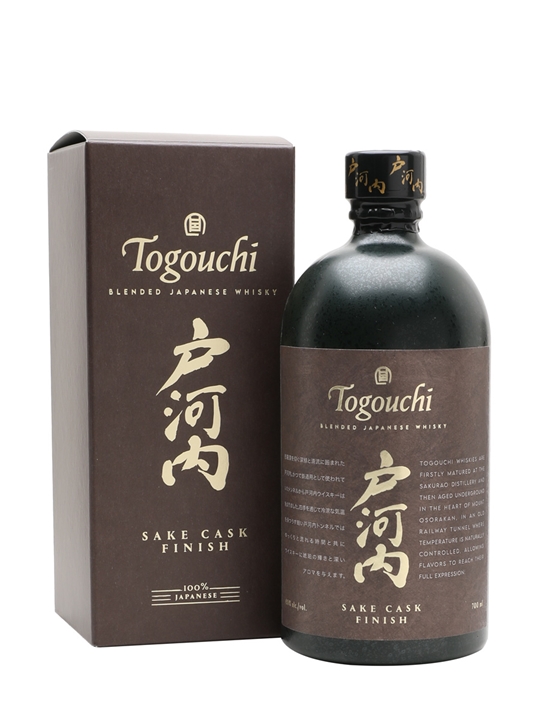

Togouchi is one of those names that tends to divide opinion in whisky circles, and I'll admit I approached this bottle with a degree of professional curiosity rather than outright enthusiasm. The brand operates out of a tunnel storage facility in Hiroshima Prefecture, maturing imported malt and grain whiskies in conditions that are, to be fair, genuinely distinctive — cool, consistent temperatures year-round in a disused railway tunnel. It's an unconventional setup, but then Japanese whisky has never been particularly interested in doing things the way Scotland does.
This particular expression takes the Togouchi blend and finishes it in sake casks, which immediately places it in that increasingly crowded 'experimental finish' category. The difference here is that sake cask finishing isn't just a marketing exercise — rice wine lees leave a very different residual character in the wood compared to your standard sherry or bourbon cask. It's a genuine point of differentiation, and at 40% ABV, Togouchi have clearly aimed this at accessibility rather than cask-strength intensity.
What to Expect
Without sake cask finishing being widely represented across the industry, this is genuinely uncharted territory for most drinkers. What you can reasonably expect from the combination of blended whisky and sake cask influence is a profile that leans towards delicacy — rice-derived fermentation tends to impart a certain soft, almost creamy quality to whatever it touches. The NAS designation means we're likely looking at younger components in the blend, but the sake cask maturation should add a layer of texture and subtlety that compensates for any youthful edges.
At 40%, this isn't a whisky that's going to shout at you. It's pitched squarely at the drinker who wants something interesting but not challenging — a weeknight pour rather than a special occasion dram. That's not a criticism; there's genuine value in a whisky that knows exactly what it's trying to be.
The Verdict
At £49.25, Togouchi Sake Cask sits in a competitive bracket. You're paying a premium over most entry-level blends, but you're also getting something that genuinely doesn't taste like anything else on your shelf. The sake cask influence is the entire proposition here, and from my experience with this bottle, it delivers enough distinctiveness to justify the ask. It's not trying to compete with the single malts coming out of Chichibu or the prestige releases from Suntory — it's doing its own thing, and doing it with a quiet confidence I rather appreciate.
I'd score this 7.7 out of 10. It loses marks for the conservative ABV and the NAS mystery, but it earns them back through sheer originality. In a market saturated with identikit bourbon-cask finishes, a sake cask blend from a tunnel in Hiroshima is, at the very least, a conversation starter. And it drinks better than it has any right to at this price point.
Best Served
This is a natural candidate for the Japanese highball treatment — tall glass, plenty of ice, good quality soda water, and if you're feeling particular about it, a thin strip of cucumber rather than citrus. The sake cask character has a delicacy that benefits from the effervescence, and the lower ABV means it won't get lost in the dilution the way some whiskies do. Alternatively, try it neat at room temperature with a few drops of water to open it up. I wouldn't waste this one in a cocktail — the subtlety is the point.