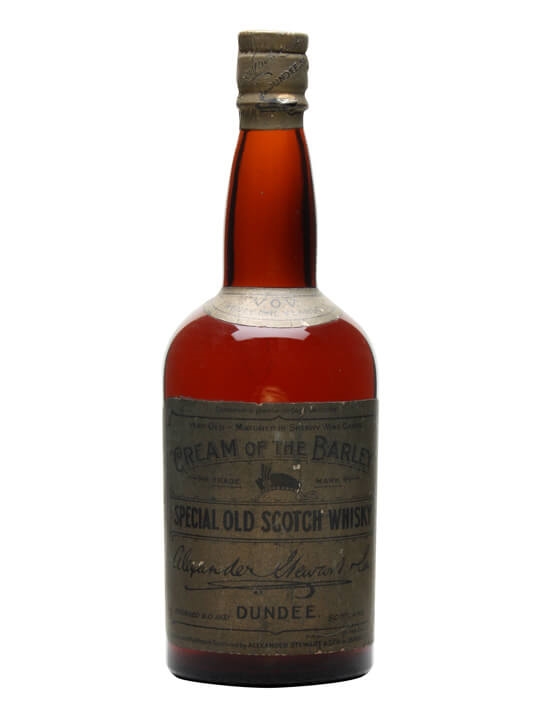

There are bottles you drink and bottles you sit with. Stewart's Cream of the Barley 21 Year Old, bottled sometime in the 1940s, is firmly in the latter camp. This is a piece of Scotch whisky history — a blended whisky from an era when the category commanded genuine respect, when age statements on blends weren't marketing afterthoughts but declarations of intent. At £1,200, you're not just buying liquid. You're buying provenance.
For those unfamiliar, Stewart's Cream of the Barley was once a staple of the Scottish blended whisky landscape, a brand that traded on smoothness and malt-forward character at a time when blends dominated global whisky consumption. The '21 Year Old' designation here is significant — this wasn't a standard release. A 21-year-old blend bottled in the 1940s means component whiskies distilled in the 1920s or earlier, a period when production methods, barley strains, and maturation practices were markedly different from anything we encounter today. The grain whisky would have been heavier, the malts more characterful, the casks almost certainly ex-sherry or plain oak of a quality that simply doesn't exist in modern supply chains.
At 40% ABV, this follows the conventions of its time. Bottling strength for premium blends of this era was standardised, and there's no reason to see that as a limitation. Whisky from the 1940s at 40% routinely delivers a density and complexity that modern bottlings at higher strengths struggle to match. The older production methods, the slower maturation conditions, the quality of the wood — it all adds up.
What to Expect
I won't fabricate detailed tasting notes for a bottle of this age and rarity — every surviving example will have its own story to tell depending on storage conditions over the intervening eight decades. What I can say is that 1940s blends of this calibre typically offer a richness and waxy depth that modern blended Scotch rarely approaches. Expect dried fruits, polished leather, old oak, and a sweetness that's more beeswax than vanilla. The 'Cream of the Barley' name wasn't accidental — the malt component was always the star here, and at 21 years old, it would have been given every opportunity to shine.
The Verdict
Is it worth £1,200? That depends entirely on what you're looking for. As a drinking experience, there are exceptional modern single malts at a fraction of the price. But as a window into a vanished era of Scotch whisky production — when blends were the pinnacle, not the poor relation — this is genuinely rare. The survival rate of 1940s bottlings in good condition is low, and Stewart's Cream of the Barley at 21 years old was a premium product even by the standards of its day. For collectors and serious whisky historians, this is a compelling buy. For anyone who wants to understand what blended Scotch was before the single malt revolution rewrote the hierarchy, there are few better educators. An 8.2 out of 10 feels right — it loses nothing for age or style, only for the inherent uncertainty of any bottle that's survived this long.
Best Served
Neat, at room temperature, in a tulip glass. Give it ten minutes to open after pouring — whisky of this age needs air. No water, no ice. If you're opening a bottle from the 1940s, you owe it your full attention. Pour small measures. Share it with someone who'll appreciate the history in the glass.