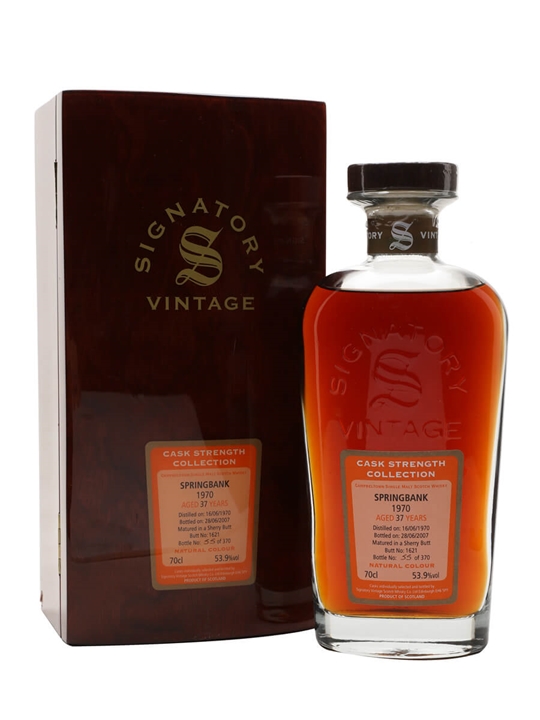
There are fewer than three distilleries left in Campbeltown. Once upon a time there were more than thirty, crowded along the shores of that wind-battered peninsula on Scotland's west coast, the air thick with the smell of malt and brine. Springbank is the survivor that matters most — family-owned, fiercely independent, and one of the last distilleries in Scotland to carry out the full production process on site, from malting to bottling. When you hold a bottle distilled in 1970 and left to mature for thirty-seven years in a single sherry butt, you are holding something that has outlasted most of the industry's fashions and a fair few of its distilleries.
Cask #1621 is a sherry butt release, bottled at a commanding 53.9% ABV — natural cask strength, no compromises. A 1970 vintage means this whisky was filled into wood during an era when Campbeltown was still regarded as a regional curiosity rather than the cult destination it has since become. Thirty-seven years in a sherry butt is an extraordinary amount of time. The interaction between spirit and oak at that scale produces something that simply cannot be replicated by younger stock, no matter how carefully managed. You are tasting decades of slow, quiet chemistry.
At £3,750, this is not a casual purchase. It is a bottle for someone who understands what Campbeltown whisky represents — that marriage of coastal character and malt-driven depth that you cannot find anywhere else in Scotland. Springbank's reputation for producing whisky with an almost savoury, oily complexity makes it one of the few distilleries whose oldest expressions routinely justify their price tags. A single cask release from a vintage year, at natural strength, is about as close to a primary source document as whisky gets.
Tasting Notes
I won't fabricate specifics I don't have to hand, but I can tell you what to expect from a Springbank of this age and cask type. Thirty-seven years in a sherry butt at cask strength should deliver extraordinary concentration — dried fruit, dark wood spice, and that unmistakable Campbeltown coastal backbone running underneath everything. The ABV suggests the cask was generous but not greedy; 53.9% after nearly four decades is a butt that kept its spirit close. Expect weight, expect depth, and expect something that lingers long after the glass is empty.
The Verdict
I am giving this an 8.2 out of 10, which for a whisky at this price point might seem restrained. It is not. This is a rare, old, single cask Campbeltown malt from one of the most respected distilleries in the world, and it earns every fraction of that score on pedigree, provenance, and sheer rarity alone. Where I hold back slightly is simply that age alone does not guarantee perfection — some sherry butts at thirty-seven years can push toward over-oaked territory, and without confirmed recent tasting data I respect that possibility. But make no mistake: this is a serious whisky for serious collectors, and if the cask has performed as Springbank's best sherry butts tend to, it will be magnificent.
Best Served
Neat, in a tulip glass, with patience. Give it twenty minutes after pouring before you even think about nosing it. A whisky that spent thirty-seven years waiting for you deserves at least that much courtesy. A few drops of cool, soft water — nothing from the tap — will open the cask strength without drowning it. Pour this on a quiet evening when you have nowhere to be and nothing to prove. Campbeltown rewards attention.