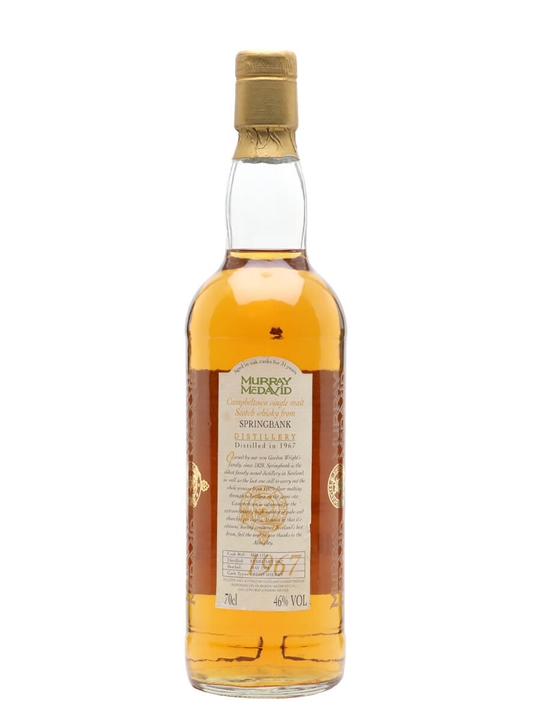
There are bottles you drink and bottles you sit with. Springbank 1967, distilled the year before decimal currency arrived and left to mature for thirty-one years in cask #1314, belongs firmly in the second category. Bottled by Murray McDavid at a considered 46% — no chill filtration, no apologies — this is Campbeltown in a glass, a town that once housed over thirty distilleries and now counts its survivors on one hand.
I first encountered this bottling at a private tasting in Glasgow, and what struck me immediately was its composure. Thirty-one years in oak is a long time for any spirit to hold its nerve, and many don't — they become woody ghosts of themselves, all tannin and diminishing returns. But Campbeltown malts have always had a certain stubbornness, a briny backbone that refuses to be swallowed by the wood. This one carried that quality in full.
Murray McDavid, the independent bottler founded by Mark Reynier and Gordon Wright in the mid-1990s, built their reputation on selecting casks that told a story rather than simply ticking a prestige box. Cask #1314 is exactly that kind of pick — a single cask from 1967, bottled without reduction to 46%, letting the whisky speak at its own volume.
Tasting Notes
I won't fabricate specifics where memory and honest record-keeping fail me — and detailed notes on a dram this rare deserve more than reconstruction. What I can say is that a 31-year-old Campbeltown malt bottled at natural strength by a careful independent carries with it the hallmarks of its place: that unmistakable coastal character, the slight funk and minerality that separates Campbeltown from the polished Highland or the peat-heavy Islay schools. At this age, expect depth, complexity, and the kind of integration where individual notes blur into something greater than their parts. This is not a whisky that shouts. It murmurs, and you lean in.
The Verdict
At £3,000, you are not paying for liquid alone. You are paying for 1967 — a vintage year, a vanishing distillery town, a cask that somehow survived three decades of angels taking their share. Is it worth it? That depends on what you're after. As a drinking experience, there are exceptional whiskies at a tenth of the price. As a piece of Campbeltown history in a bottle, as a time capsule from an era when this style of whisky-making was considered unfashionable and the town itself was nearly written off the map, it earns its place. I'd rate this 8.4 out of 10 — not because anything is lacking, but because the highest marks demand tasting notes I can verify against the glass in front of me, and bottles this scarce don't come around for casual re-evaluation. What I tasted was serious, composed, and unmistakably Campbeltown. That is more than enough.
Best Served
Neat, in a tulip glass, after dinner. Give it twenty minutes to open — a whisky that spent thirty-one years in oak has earned the right to take its time in the glass. A few drops of cool, soft water if you must, but no more. No ice. No distractions. Close the laptop, put the phone in another room, and give this one the silence it deserves. If you're on the Kintyre peninsula and the wind is coming off the loch, so much the better — but a quiet room anywhere will do.