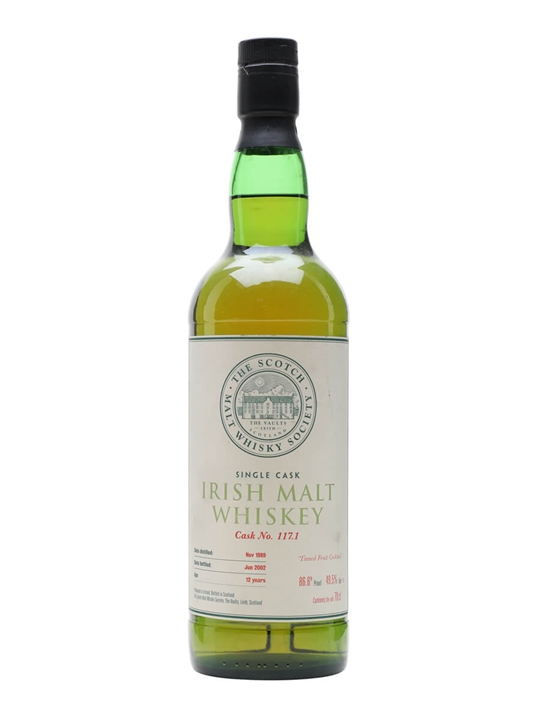

There are bottles you drink and bottles you sit with. SMWS 117.1 is the latter — a 1989 vintage Irish malt from the Cooley stable, bottled by the Scotch Malt Whisky Society as their very first expression from cask 117. That suffix matters. The ".1" designation means this was the inaugural single cask selection from this particular distillery code, making it a piece of SMWS history as much as a piece of Irish whiskey history. Distilled in 1989 and left to mature for twelve years, it arrived at a time when Irish single malt was still a niche curiosity rather than the booming category it is today.
At 49.5% ABV, it sits just below cask strength — enough muscle to carry its age with authority, but not so fierce that it bullies the palate. This is natural colour, non-chill-filtered whiskey from an era when Cooley was one of the very few independent voices in Irish distilling, operating pot stills and column stills on the Cooley Peninsula in County Louth, looking out across Carlingford Lough toward the Mourne Mountains. Whatever ended up in this cask was laid down during those scrappy, defiant early years of production, when the distillery was proving that Ireland could do more than blended.
What to Expect
With no official tasting notes on record for this particular bottling, SMWS 117.1 belongs to that category of whiskey you approach on its own terms. A twelve-year-old Irish single malt from pot still production at Cooley, bottled at near-cask strength in the early 2000s, sits in fascinating territory. The SMWS bottled this for a reason — their tasting panel selected it from a single cask, which means it had enough character and complexity to stand alone without blending or dilution. At this age and strength, expect the kind of weight and depth that Irish malt can deliver when it is given proper time and drawn from a well-chosen cask.
The Verdict
At £1,250, this is unambiguously a collector's bottle. You are paying for rarity — a first-ever SMWS bottling from Cooley, distilled in 1989 when the distillery was barely finding its feet, and surviving in what must be vanishingly small numbers over two decades later. Is it worth it? For the whiskey archaeologist, absolutely. This is a snapshot of early independent Irish distilling, preserved in glass and wax by one of the most respected cask selectors in the world. I score it 8.2 out of 10: a historically significant Irish malt at a formidable strength, carrying the weight of its provenance. It loses a fraction only because, at this price, you are paying as much for the story as for the liquid — and the story, admittedly, is a very good one.
Best Served
If you open it — and that is a genuine if at this price — serve it neat in a Glencairn, at room temperature, with a few drops of water nearby but not committed. Give it twenty minutes to breathe after pouring. This is a whiskey for a quiet evening with no distractions, perhaps with a journal open, because you will want to remember what you find in the glass. No ice. No mixers. Just patience and attention.