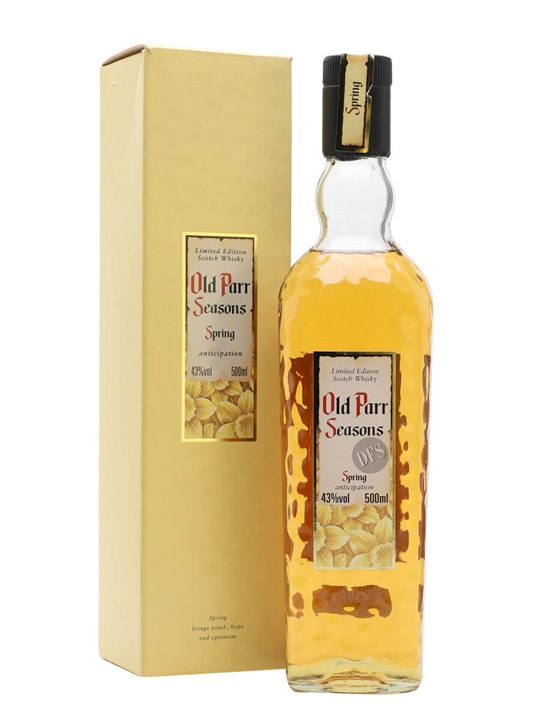

Old Parr is one of those brands that tells you everything about how the Scotch industry actually works if you know where to look. Named after Thomas Parr — the Shropshire man who allegedly lived to 152 — it's been a quiet giant in export markets for decades, particularly Latin America and Japan, while remaining almost invisible on UK shelves. The brand sits within Diageo's portfolio, and its historical backbone has been Cragganmore malt, though the exact composition of any given expression is, as ever with blends, a closely guarded detail. So when Old Parr Seasons / Spring lands at £125 and 43% ABV with no age statement, you're paying for craft direction rather than a number on the box. And honestly? That's not a bad thing.
What to Expect
The Seasons range is Old Parr's attempt at something more curated — a limited, thematic collection that leans into character rather than age. Spring, as the name suggests, should sit at the lighter, more floral end of the blended Scotch spectrum. At 43% ABV, it's bottled above the industry-standard 40%, which is a small but meaningful signal: there's enough confidence in the liquid to give it a touch more body and delivery without cask-strength posturing. NAS blends at this price point live or die on the quality of their grain-to-malt ratio and the skill of the blending team. Given Diageo's deep reserves of aged stock across dozens of distilleries, the raw materials are there. The question is always whether the final composition has a point of view — and Spring does.
This is a blend that feels deliberate. It's not trying to mimic a single malt, and it's not apologising for being a blend. There's a brightness to it, a freshness that justifies the seasonal branding without feeling gimmicky. I found it genuinely easy to drink — dangerously so for something at this price — with a clean delivery that doesn't linger in heavy peat or dark sherry. It knows what it is.
The Verdict
At £125, Old Parr Seasons / Spring is competing in crowded territory. You're up against well-aged single malts, premium Japanese blends, and the growing wave of independent bottlings. What Spring offers in return is polish and precision — this is a blender's whisky, made by people who understand how to balance grain sweetness against malt complexity without letting either dominate. It's the kind of bottle that rewards anyone who's stopped equating age statements with quality and started paying attention to what's actually in the glass.
I'm giving it an 8/10. It's not going to rewrite your understanding of Scotch, but it's a genuinely well-made blend that delivers more character than most bottles at this price. The seasonal concept gives Diageo room to experiment within a heritage brand, and on the evidence of Spring, they're using that room well. If you can find it — and availability outside key export markets can be patchy — it's worth the spend.
Best Served
Spring rewards a light touch. Pour it neat in a Glencairn at room temperature and let it sit for five minutes — the extra ABV opens up nicely with a little air. If you want to stretch it, a few drops of cold water work well; ice is fine for a warm afternoon but you'll lose some of the subtlety. This would also make a genuinely excellent highball — good soda water, a long glass, and a twist of lemon peel. The Japanese market has known for years that Old Parr is brilliant in a highball, and Spring's lighter profile is practically built for it.