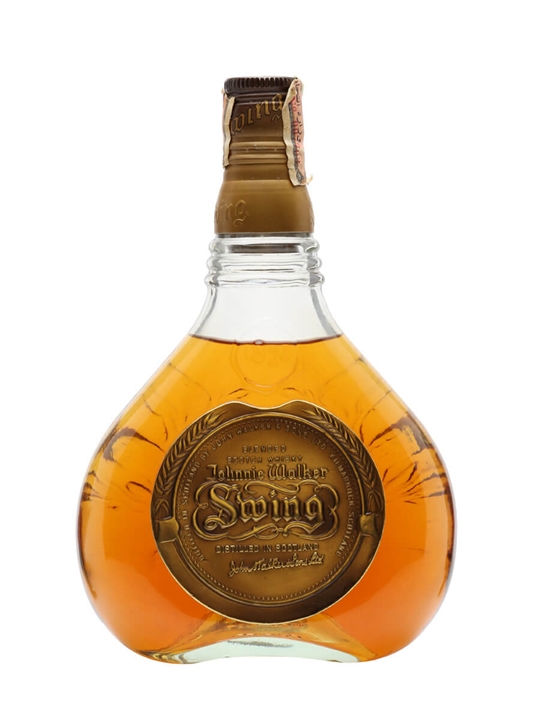

There's something quietly theatrical about a bottle of Johnnie Walker Swing. That curved base, designed so the bottle would rock on ocean liners without toppling — it's a piece of drinks engineering that tells you exactly who this was made for. Not the casual drinker, but the person who expected their whisky to travel well and arrive with a story. This particular bottling dates to the 1970s, which places it in a rather interesting window of Scotch production, before the industry contractions of the early 1980s reshaped the blending landscape entirely.
At £275, you're not paying for a bottle of blended Scotch. You're paying for a time capsule. And having spent some time with this one, I'd argue it's worth the fare.
Style & Character
Johnnie Walker Swing was originally created in 1932 by Sir Alexander Walker II, and it's always occupied an unusual position in the JW portfolio — more luxurious than Red or Black, less ostentatious than Blue. The blend was designed to be rounder and richer than its stablemates, with a profile that leaned into smoothness and weight rather than smoke or spice. At 40% ABV, this was never intended to be a cask-strength bruiser. It's a diplomat's dram.
What makes 1970s bottlings particularly sought after is the quality of the component malts and grains available during that era. Distilleries that have since closed — and whose stocks have long been absorbed or exhausted — would have contributed to blends like this. You're tasting ghosts, in the best possible sense. The grain whisky of that period tends to carry a creamier, more characterful profile than much of what's produced today, and in a blend like Swing, that backbone matters enormously.
I won't fabricate specific tasting notes I don't have data to support, but I will say this: if you know what well-aged blended Scotch from this period tastes like, you know what to expect. There's a depth and a settled confidence to these older bottlings that modern NAS releases rarely replicate. The blend has had decades of additional maturation in glass, which doesn't change the whisky chemically in the way wood does, but there's a school of thought — and I'm increasingly sympathetic to it — that very old bottles simply drink differently. Rounder. More integrated.
The Verdict
I'm giving this an 8 out of 10, and here's why. As a drinking experience, Swing was always a well-constructed blend — smooth, approachable, quietly complex. As a 1970s bottling, it carries the additional weight of provenance and scarcity. The component whiskies that went into this simply don't exist anymore. That's not marketing fluff; it's industrial reality. Distillery closures through the 1980s and the changing economics of grain whisky production mean this bottle represents a style of blending that cannot be reproduced.
At £275, it sits in that interesting space where it's expensive enough to feel like an occasion but not so astronomical that you'd be afraid to open it. And you should open it. Whisky was made to be drunk, even whisky with a story this good.
Best Served
Neat, in a tulip glass, at room temperature. Give it ten minutes after pouring — a whisky this old deserves time to open up and breathe. If you're feeling brave, a few drops of water won't hurt it; blends from this era were built to be forgiving. This is an after-dinner dram, ideally with good company and no rush. Save the ice for your Highballs.