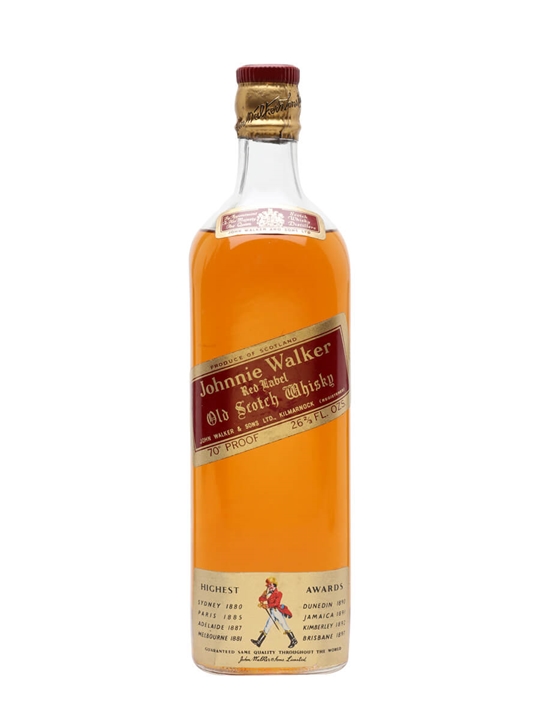

There's something quietly thrilling about holding a bottle of Johnnie Walker Red Label from the 1960s. Not because it's rare in the conventional sense — Red Label was, and remains, one of the most widely distributed blended Scotch whiskies on the planet. But because this particular bottle represents a snapshot of an era when blending was considered the highest art in Scotch whisky, when the liquid inside these bottles was assembled from components we can now only speculate about, and when the economics of the industry meant that what went into an entry-level blend was often far more generous than anything a modern accountant would sanction.
I should be clear about what this is. This is not a contemporary bottle of Red Label — a perfectly serviceable mixer that retails for around £15. This is a 1960s bottling, priced at £275, and that price reflects not the brand but the era. If you've ever wondered what mass-market Scotch tasted like before the whisky loch dried up, before grain-to-malt ratios were optimised for margin, before globalisation turned blending into a volume game — this is your chance to find out.
At 40% ABV with no age statement, the spec sheet looks identical to what you'd pick up in any airport today. But the spec sheet is lying to you. The component malts available to Johnnie Walker's blenders in the 1960s — drawn from a Diageo predecessor portfolio that included distilleries operating at very different capacities and with very different character profiles — would have produced a fundamentally different liquid. The grain whisky, too, would have been distilled under different conditions, likely with more character than the ultra-clean spirit produced by modern column stills running at peak efficiency.
Tasting Notes
I won't fabricate specific tasting notes from memory — this is a bottle where the joy is in the discovery, and your experience will depend heavily on storage conditions over the past six decades. What I can say is that well-stored 1960s blends of this calibre routinely show a richness, a malty depth, and a complexity that would embarrass many single malts at twice the price. Expect a broader, more characterful experience than any modern Red Label would deliver. The balance between grain sweetness and malt influence tends to be more harmonious in these older bottlings, with none of the thin, spirity edges that cheaper modern blends can exhibit.
The Verdict
At £275, this sits in an interesting space. It's expensive for a blended Scotch, obviously. But as a piece of drinkable whisky history, it's actually reasonably priced — comparable bottlings from the same era regularly fetch more at auction, and unlike a dusty bottle of single malt, a 1960s blend offers something you genuinely cannot replicate today. The recipe, the components, the production methods — none of it exists any more. You're not paying for a label. You're paying for a time capsule.
I'm giving this an 8.1 out of 10. That's a strong score for a bottle whose contents I'm assessing partly on category reputation and era, but the track record of well-kept 1960s Johnnie Walker is remarkably consistent. If the storage has been kind, this will reward you handsomely.
Best Served
Neat, at room temperature, in a proper nosing glass. This is not a bottle you mix with ginger ale. Pour a small measure, let it open up for five to ten minutes, and pay attention. If you want to add a few drops of water, do so — but taste it unadorned first. You owe it that much respect. And frankly, at £275, you owe it to your wallet.