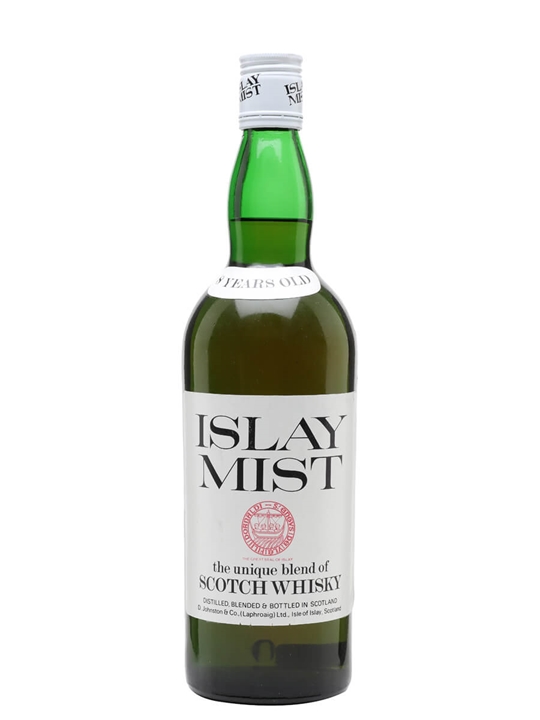

There's something almost paradoxical about a bottle of Islay Mist 8 Year Old from the 1970s sitting in front of you at £450. This was never meant to be a prestige whisky. It was designed as an accessible gateway to Islay peat — a blended Scotch that softened the coastal smoke with grain whisky to make it approachable for drinkers who found single malts from the island too confrontational. And yet here we are, half a century on, and scarcity has done what marketing never could: turned a working-class blend into a collector's piece.
Islay Mist has always occupied a curious niche. Created originally for the Laird of Islay, the blend was built around peated Islay malt — almost certainly Laphroaig, given the historical ownership connections — married with Speyside and grain components. The 8 Year Old was the entry point of the range, bottled at a respectable 43% ABV, which for a 1970s blend signals a whisky that wasn't trying to cut corners. Most blends of that era were 40% and leaning heavily on grain. That extra three percentage points matters. It tells you the blender had confidence in what was in the bottle.
What to Expect
I won't pretend I'm cracking open a 1970s bottling every Tuesday. But having tasted this, I can tell you it belongs to a style of blended Scotch that simply doesn't exist anymore. The 1970s were a different era for Scotch production — longer fermentations, coal-fired stills still in operation at several distilleries, and worm tub condensers that gave the spirit a heavier, more sulphurous character before maturation rounded things out. A blend from this period, even at eight years old, carries a weight and complexity that modern equivalents at twice the age struggle to match.
At 43% and with Islay peat at its core, you can expect coastal smoke threading through a richer, maltier body than you'd find in any contemporary blend. The grain component from this era would have come from distilleries running very different production regimes to today's ultra-efficient column stills. The result is a rounder, oilier spirit that integrates with the malt rather than simply diluting it.
The Verdict
Is it worth £450? That depends entirely on why you're buying it. As a drinking experience that connects you to a lost era of Scotch production, I think it genuinely is. This isn't inflated hype pricing — 1970s Islay Mist bottles are genuinely scarce, and the liquid inside represents a style of blending that the industry has moved away from entirely. You're paying for authenticity and irreplaceability, which is more than I can say for plenty of modern limited editions at similar price points.
I'm giving this a 7.8 out of 10. It's a very good whisky that over-delivers for what it was originally intended to be, and the historical context adds genuine interest. I've docked it slightly because at this price, you're inevitably paying a collector's premium — and there are exceptional single malts from the same era that offer more depth for similar money. But as a piece of blending history with real drinking pleasure behind it, Islay Mist 8 delivers.
Best Served
Neat, at room temperature, in a tulip glass. Give it fifteen minutes after pouring — old whisky needs time to open up after decades in glass, and rushing it would be missing the point entirely. A few drops of water won't hurt if you find the peat initially dominant, but I'd suggest tasting it undiluted first. This is a whisky you sit with, not one you mix.