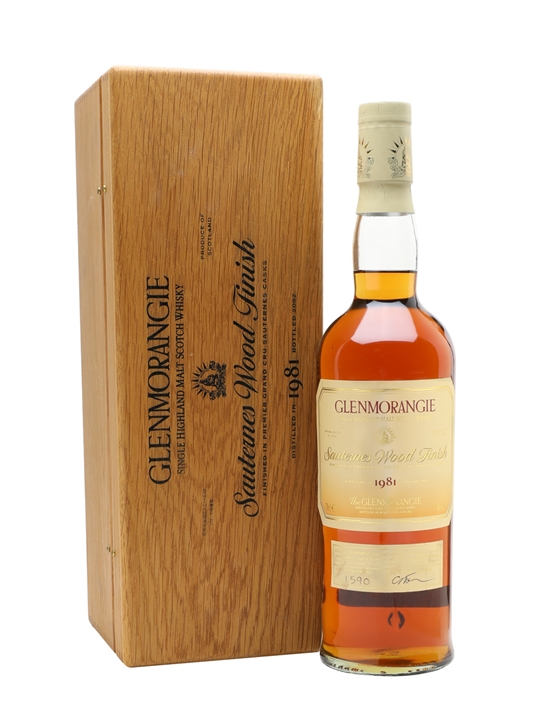

There are bottles that sit on a shelf and whisper of a particular moment in time, and the Glenmorangie 1981 Sauternes Wood Finish is precisely that sort of whisky. Distilled in 1981 and granted a full twenty-one years to mature before its finishing period in former Sauternes wine casks, this is a Highland single malt that carries the weight of its era with genuine grace. At 46% ABV — bottled without chill filtration, one hopes — it arrives with enough backbone to support what must be a considerable depth of character after two decades in oak.
I should note upfront: the distillery behind this bottling is not confirmed beyond the Glenmorangie name on the label. That said, the house style from Tain is well-established — light, elegant, fruit-forward — and a 1981 vintage would have been produced during a period when the distillery was still operating its famously tall copper pot stills, the tallest in Scotland, which have always encouraged a cleaner, more delicate new-make spirit. That foundation matters enormously when you are asking a whisky to spend over two decades in wood.
What to Expect
The Sauternes wood finish is what makes this bottling particularly interesting. Sauternes, for the uninitiated, is a sweet Bordeaux wine made from botrytised grapes — noble rot, as the winemakers call it — and the casks it leaves behind carry an unmistakable honeyed, apricot-rich sweetness. Married with a Highland malt of this age, you would expect the result to sit somewhere between tropical fruit compote and old beeswax, with the kind of layered complexity that only time in good wood can produce. At twenty-one years, the oak influence will be significant but should remain in balance at this strength. The 46% ABV is a sensible choice — enough to preserve texture and aromatic intensity without overwhelming the palate.
This is emphatically a collector's and connoisseur's whisky. At £1,450, it is not a casual purchase, and it does not pretend to be. What you are paying for is provenance: a specific vintage, a specific finishing technique that Glenmorangie helped pioneer in the early days of wood experimentation, and the patience required to hold stock for this long. Whether the price represents fair value depends entirely on what you are looking for. As an experience, as a piece of whisky history from a house that helped define the modern era of cask finishing — I think it justifies serious consideration.
The Verdict
I have always believed that the best Glenmorangie releases are the ones that lean into the distillery's natural elegance rather than fighting against it, and a Sauternes finish on a whisky of this age feels like exactly the right pairing. The sweet, honeyed character of the wine cask should complement rather than compete with the Highland spirit beneath. At 8.2 out of 10, this is a whisky I rate highly — not because it shouts, but because everything about it suggests restraint, thoughtfulness, and a commitment to getting the balance right. It loses a fraction only because, at this price point, I would like to see full transparency on the production details and finishing duration. But as a drinking experience and a snapshot of early-2000s cask innovation built on 1980s distillation, it is a compelling bottle.
Best Served
Neat, in a tulip-shaped nosing glass, at room temperature. Give it a full ten minutes to open after pouring. If you feel the 46% carries any heat — unlikely after this length of maturation, but possible — add no more than a few drops of soft water. This is not a whisky for cocktails or ice. It has earned the right to be taken on its own terms.