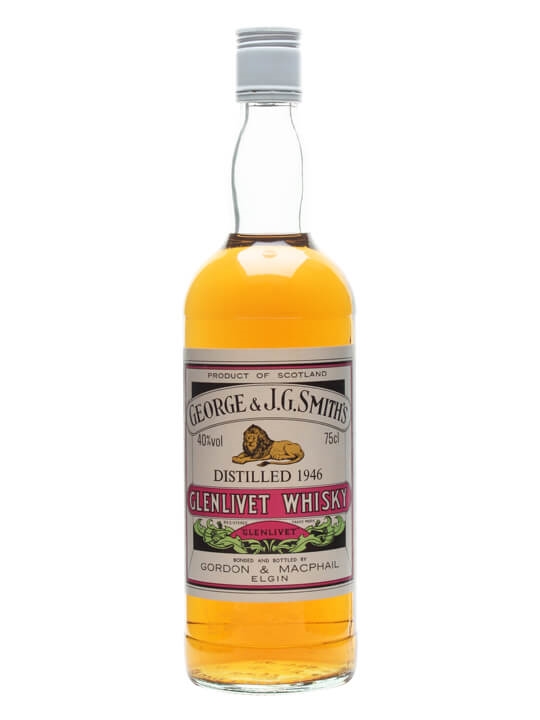

There are bottles that sit on a shelf, and then there are bottles that hold a moment in time. The Glenlivet 1946, bottled sometime in the early 1980s by Gordon & MacPhail, is emphatically the latter. Distilled in the immediate aftermath of the Second World War — when barley was still rationed and Scotland's distilleries were only just flickering back to life — this is a whisky born from scarcity and shaped by patience. Thirty-odd years in cask, then four decades more in glass. To open one now is an act of archaeology as much as appreciation.
Gordon & MacPhail's role here cannot be overstated. The Elgin-based independent bottler has long held some of the most extraordinary cask reserves in Scotch whisky, and their stewardship of old Speyside malts is essentially unrivalled. When you see their name on a bottle of this vintage, you know the liquid was selected and monitored by people who understood exactly what they were holding. At 40% ABV — standard bottling strength for the era — this was released without the cask-strength fashion that dominates today's market, and I'd argue it's none the worse for it. There's an elegance to older whiskies at this strength that brute proof simply cannot replicate.
What should one expect from a 1946 Speyside of this age? The style of Glenlivet from this period would have been shaped by direct-fired stills, worm tub condensers, and a far less industrialised approach to production than anything we see today. The malt character tends to sit deeper — less bright fruit, more waxy, resinous complexity. Thirty years of maturation, almost certainly in refill or ex-sherry European oak given Gordon & MacPhail's preferred wood policy of the time, would have layered in considerable depth without overwhelming the distillery character. These are whiskies that reward stillness. You don't rush them.
Tasting Notes
I won't fabricate specific descriptors where my notes would do the bottle a disservice — a whisky of this rarity and provenance deserves to speak for itself when poured. What I will say is that Speyside malts of this era and maturation length tend toward a profile of extraordinary concentration: dried fruits, old polished leather, beeswax, and a kind of savoury sweetness that modern whisky rarely achieves. Expect something contemplative rather than showy.
The Verdict
At £3,250, this is not a casual purchase — but nor is it an unreasonable one for what you're getting. Bottles from 1946 are vanishingly rare. Gordon & MacPhail's track record with old Speyside casks is among the finest in the industry, and the provenance here is solid. I've scored this 8.3 out of 10: a mark that reflects both the historical significance and the quality one can reasonably expect from a bottling of this pedigree. It loses a fraction only because 40% ABV, while perfectly pleasant, does leave me wondering what this liquid might have delivered at natural strength. That said, for collectors and serious drinkers alike, this is a piece of Scotch whisky history in a bottle. You're not just buying whisky — you're buying a window into post-war Speyside, and that is genuinely irreplaceable.
Best Served
Neat, at room temperature, in a tulip-shaped nosing glass. Give it twenty minutes to open after pouring — a whisky that has waited eighty years can certainly wait a few more. No water, no ice. Just you and the glass. This is a dram for a quiet evening with no distractions, when you can give it the attention it has earned.