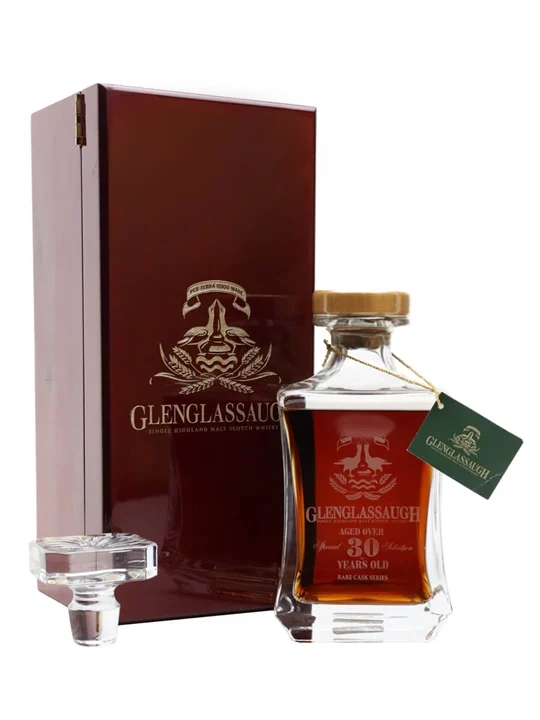

There are bottles that sit on a shelf and quietly demand your attention — not through flash or fanfare, but through sheer weight of years. The Glenglassaugh 1972, a 36-year-old Highland single malt bottled at 43.2% ABV, is precisely that kind of whisky. Distilled in 1972 and left to mature for over three decades, this is a spirit that carries the full gravity of its age in every aspect of its presentation.
Glenglassaugh is a distillery that has lived several lives. Its periods of silence — long stretches where the stills sat cold — make surviving casks from its earlier eras genuinely rare. A 1972 vintage, then, is not simply old whisky; it is a fragment of a production era that cannot be repeated. At 36 years of age, this expression sits firmly in the territory where oak influence and spirit character are locked in a delicate negotiation, and the 43.2% bottling strength suggests a careful decision to present it at a point of balance rather than chasing cask-strength bravado.
What to Expect
A Highland malt of this age and vintage belongs to a particular school of whisky. You should expect a spirit where decades of slow maturation have drawn out deep complexity — dried fruits, polished wood, old leather, perhaps a thread of gentle smoke or coastal minerality that speaks to Glenglassaugh's position on the Banffshire coast. At 43.2%, the delivery will be soft and considered, with the kind of layered texture that only genuinely old whisky can achieve. This is not a dram that shouts. It arrives quietly and stays for a very long time.
The age here is not a gimmick. Thirty-six years in oak is a serious commitment, and not every cask survives that journey with its character intact. That this bottling exists at all — at a strength that suggests the cask was still vibrant — speaks well of the wood selection and the warehousing conditions that kept it alive.
The Verdict
At £4,000, this is unambiguously a collector's whisky, and I think the price reflects the reality of the market for aged Highland malts from distilleries with interrupted production histories. Is it worth it? That depends entirely on what you are looking for. As a piece of whisky history — a taste of a distillery in a specific moment of its existence — I find it genuinely compelling. The 1972 vintage places this in an era of Scottish distilling that predates much of the commercial expansion of the late twentieth century, and there is something meaningful about that provenance.
I am scoring this 8.2 out of 10. The age, the rarity, and the careful bottling strength all point to a whisky that was handled with real respect. It loses a little ground only because, at this price point, I hold every dram to an exacting standard, and without confirmed distillery details I must let the liquid speak for itself rather than lean on heritage. But what speaks here is worth listening to — this is a serious, contemplative Highland malt that rewards patience and attention.
Best Served
Neat, in a tulip glass, at room temperature. Give it fifteen minutes to open after pouring — a whisky of this age has spent thirty-six years in conversation with oak, and it deserves a few minutes to find its voice in the glass. A few drops of still water may coax out additional nuance, but add them sparingly. This is not a dram for cocktails or casual mixing. Sit with it. A whisky like this has earned that much.