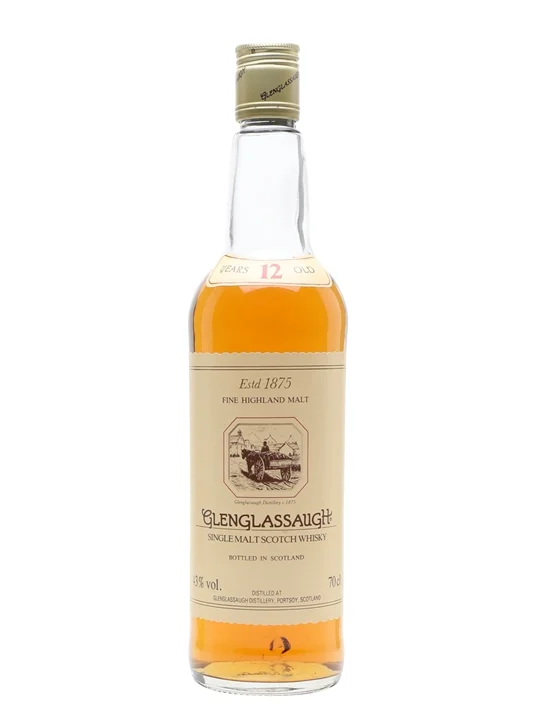

There are bottles that sit quietly on the shelf and speak volumes about a particular moment in Scottish whisky history. The Glenglassaugh 12 Year Old, bottled sometime in the 1990s, is precisely that kind of dram. For those unfamiliar, Glenglassaugh is a coastal Speyside distillery that spent long stretches of the twentieth century in silence — mothballed, overlooked, and largely forgotten by the mainstream. That makes any bottling from its operational periods something of a minor treasure, and this 12 Year Old is no exception.
At 43% ABV, this sits just above the standard 40% floor, which tells me the bottlers had at least some regard for delivering the spirit with a touch more body and presence. It's a small detail, but one I always appreciate. Too many distilleries of that era were content to bottle at the bare minimum. That extra few percentage points can make all the difference in how a whisky carries itself across the palate.
What draws me to this bottle is context. Glenglassaugh has always occupied an unusual position within Speyside. It lacks the commercial ubiquity of the big-name distilleries, and its output during its active periods was comparatively modest. A 1990s bottling of their 12 Year Old represents whisky distilled during a period when the distillery was producing spirit largely for blending houses, meaning any official single malt release from that window was something of a statement — a chance for the distillery to show what it could do on its own terms.
Speyside as a region tends toward a house style that favours approachability: orchard fruit, gentle malt sweetness, a certain honeyed warmth. At twelve years of maturation, you'd expect this Glenglassaugh to sit comfortably within that tradition while showing its own coastal inflection — that faint mineral edge that distinguishes it from the more landlocked distilleries further south. It's the kind of whisky that rewards patience and a willingness to let it open up in the glass.
Tasting Notes
I won't fabricate specific tasting notes for a bottle of this age and scarcity — every example will have aged differently depending on storage conditions over the past three decades. What I can say is that the Speyside character at 43% with twelve years of maturation should deliver a whisky of genuine substance, with enough complexity to hold your attention and enough restraint to remain elegant.
The Verdict
At £150, this is not an everyday purchase. But nor should it be. You're paying for a piece of distillery history — a snapshot of Glenglassaugh during a period when few people were paying attention. The whisky world has since caught up, and bottles like this have become increasingly difficult to source. For collectors and serious drinkers who appreciate the quieter corners of Speyside, this represents genuine value. An 8.1 out of 10 feels right: a strong, characterful dram with real provenance, marked down only slightly by the inherent uncertainty of a bottle that has spent decades waiting to be opened.
Best Served
Neat, in a tulip-shaped nosing glass, with five minutes of air before your first sip. If you find it needs opening up further, a few drops of still water at room temperature will do the job. This is not a whisky for cocktails or ice — it deserves your full attention.